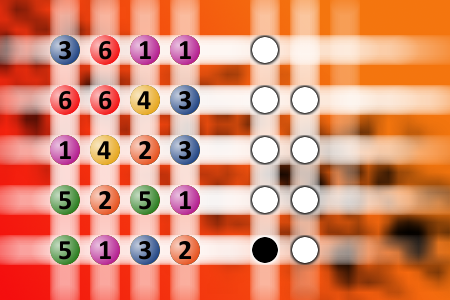
Which is a winning combination of digits?
The computer chose a secret code (sequence of 4 digits from 1 to 6). Your goal is to find that code. Black circles indicate the number of hits on the right spot. White circles indicate the number of hits on the wrong spot.
Annual Convention
A man boarded an airplane and took his seat. As he settled in, he glanced up and saw the most beautiful woman boarding the plane. He soon realized she was heading straight towards his seat... As fate would have it, she took the seat right beside his.
Eager to strike up a conversation he blurted out, "Business trip or pleasure?" She turned, smiled and said, "Business. I'm going to the Annual Nymphomaniacs of America Convention in Boston"
He swallowed hard. Here was the most gorgeous woman he had ever seen sitting next to him, and she was going to a meeting of nymphomaniacs.
Struggling to maintain his composure, he calmly asked, "What's your business role at this convention?" "Lecturer," she responded. "I use information that I have learned from my personal experiences to debunk some of the popular myths about sexuality."
"Really?" he said. "And what kind of myths are there?"
"Well," she explained, "one popular myth is that African-American men are the most well-endowed of all men, when in fact it is the Native American Indian who is most likely to possess that trait.
Another popular myth is that Frenchmen are the best lovers, when actually it is men of Jewish descent who are the best. I have also discovered that the lover with absolutely the best stamina is the Southern Redneck."
Suddenly the woman became a little uncomfortable and blushed. "I'm sorry," she said, "I shouldn't really be discussing all of this with you. I don't even know your name.."
"Tonto," the man said, "Tonto Goldstein, but my friends call me Bubba."