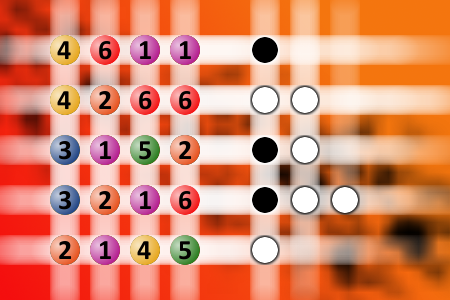
Which is a winning combination of digits?
[6059] Which is a winning combination of digits? - The computer chose a secret code (sequence of 4 digits from 1 to 6). Your goal is to find that code. Black circles indicate the number of hits on the right spot. White circles indicate the number of hits on the wrong spot. - #brainteasers #mastermind - Correct Answers: 24 - The first user who solved this task is Nasrin 24 T
BRAIN TEASERS
enter your answer and press button OK

Which is a winning combination of digits?

The computer chose a secret code (sequence of 4 digits from 1 to 6). Your goal is to find that code. Black circles indicate the number of hits on the right spot. White circles indicate the number of hits on the wrong spot.
Correct answers: 24
The first user who solved this task is Nasrin 24 T.
#brainteasers #mastermind
Register with your Google Account and start collecting points.
Check your ranking on list.

Aoccdrnig to a rscheearch at a...

Aoccdrnig to a rscheearch at an Elingsh uinervtisy, it deosn't mttaer inwaht oredr the ltteers in a wrod are, the olny iprmoetnt tihng is taht thefrist and lsat ltteer is at the rghit pclae. The rset can be a toatl msesand you can sitll raed it wouthit porbelm. Tihs is bcuseae we do not raedervey lteter by it slef but the wrod as a wlohe.
Preosllnay I tinhk its cmolpete nenosnese......
Jokes of the day - Daily updated jokes. New jokes every day.
Follow Brain Teasers on social networks

Brain Teasers

puzzles, riddles, mathematical problems, mastermind, cinemania...

James Blundell

Died 15 Jan 1878 at age 87 (born 27 Dec 1790).English obstetrician and medical researcher who researched in the technique of blood transfusion, and was the first in Great Bitain to perform the procedure using human blood (rather than animal blood) on 26 Sep 1818 at Guy's Hospital, London. He used an apparatus of his his own design to collect and transfer the blood. His patient, who had an incurable disease, was anxious to try a blood transfusion from human donors. Although there seemed initial signs of benefit, he survived only another 56 hours. In the years that followed, his technique eventually led to saving lives, despite failures until the significance of matching blood types known after 1900.«
This site uses cookies to store information on your computer. Some are essential to help the site properly. Others give us insight into how the site is used and help us to optimize the user experience. See our privacy policy.