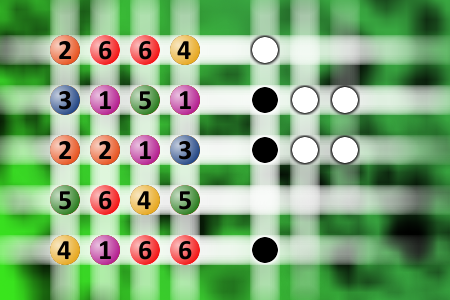
Which is a winning combination of digits?
The computer chose a secret code (sequence of 4 digits from 1 to 6). Your goal is to find that code. Black circles indicate the number of hits on the right spot. White circles indicate the number of hits on the wrong spot.Correct answers: 32
The first user who solved this task is Nílton Corrêa de Sousa.
#brainteasers #mastermind

A mathematician, a physicist...
A mathematician, a physicist, and an engineer are all given identical rubber balls and told to find the volume. They are given any tools they want, and have all the time they need.
The mathematician uses a measuring tape to record the circumference. He then divides by two times pi to get the radius, cubes that, multiplies by pi again, and then multiplies by four-thirds and thereby calculates the volume.
The physicist gets a bucket of water, places 1.000000 gallons of water in the bucket, drops in the ball and measures the displacement to six significant figures.
The engineer writes down the serial number of the ball and looks it up online.
The mathematician uses a measuring tape to record the circumference. He then divides by two times pi to get the radius, cubes that, multiplies by pi again, and then multiplies by four-thirds and thereby calculates the volume.
The physicist gets a bucket of water, places 1.000000 gallons of water in the bucket, drops in the ball and measures the displacement to six significant figures.
The engineer writes down the serial number of the ball and looks it up online.