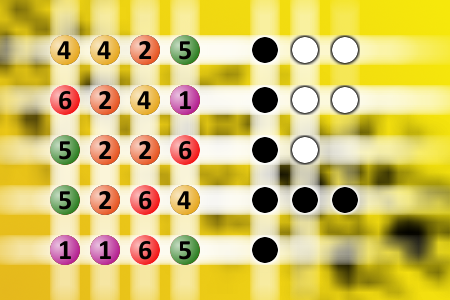
Which is a winning combination of digits?
[6143] Which is a winning combination of digits? - The computer chose a secret code (sequence of 4 digits from 1 to 6). Your goal is to find that code. Black circles indicate the number of hits on the right spot. White circles indicate the number of hits on the wrong spot. - #brainteasers #mastermind - Correct Answers: 23 - The first user who solved this task is Nasrin 24 T
BRAIN TEASERS
enter your answer and press button OK

Which is a winning combination of digits?

The computer chose a secret code (sequence of 4 digits from 1 to 6). Your goal is to find that code. Black circles indicate the number of hits on the right spot. White circles indicate the number of hits on the wrong spot.
Correct answers: 23
The first user who solved this task is Nasrin 24 T.
#brainteasers #mastermind
Register with your Google Account and start collecting points.
Check your ranking on list.

A blonde arrived for her first...

A blonde arrived for her first golf lesson and the pro asked her to take a swing at a ball to see how she'd do.
The blonde did so and completely duffed the shot.
The pro said, "Your swing is good but you're gripping the club too hard grip the club gently as you would your husband's penis."
The blonde took another shot and nailed the ball 275 yards straight down the fairway.
The pro said, "That was excellent!! Let's try it again, only this time take the club out of your mouth."
Jokes of the day - Daily updated jokes. New jokes every day.
Follow Brain Teasers on social networks

Brain Teasers

puzzles, riddles, mathematical problems, mastermind, cinemania...

John Pringle Nichol

Born 13 Jan 1804; died 19 Sep 1859 at age 55. Scottish astronomer and author who, after a few years early in his career as a teacher and headmaster, was appointed in 1836 as Regius Professor of Practical Astronomy at the University of Glasgow, where he spent the rest of his life. While in this position, he also became a popular public lecturer on astronomy and wrote a number of books on science. His fund-raising efforts paid for a new observatory atHoreslethill (1841), which was acquired by the University in 1845. While giving lectures in Natural Philosophy during the two-year absence during the illness of a colleague, it is said he inspired William Thomson as a young student who later became the famed Lord Kelvin. Nichols' last complete work was a Dictionary of the Physical Sciences.
This site uses cookies to store information on your computer. Some are essential to help the site properly. Others give us insight into how the site is used and help us to optimize the user experience. See our privacy policy.