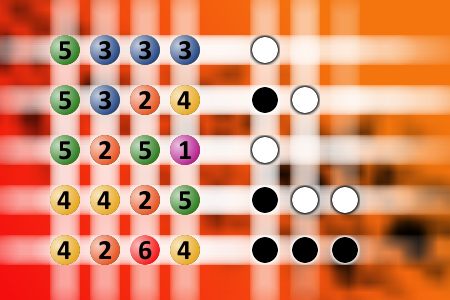
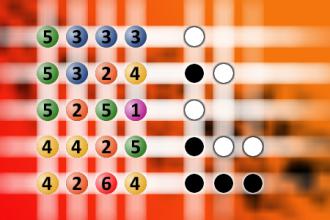
Which is a winning combination of digits?
[6226] Which is a winning combination of digits? - The computer chose a secret code (sequence of 4 digits from 1 to 6). Your goal is to find that code. Black circles indicate the number of hits on the right spot. White circles indicate the number of hits on the wrong spot. - #brainteasers #mastermind - Correct Answers: 23 - The first user who solved this task is Nasrin 24 T
BRAIN TEASERS
enter your answer and press button OK

Which is a winning combination of digits?

The computer chose a secret code (sequence of 4 digits from 1 to 6). Your goal is to find that code. Black circles indicate the number of hits on the right spot. White circles indicate the number of hits on the wrong spot.
Correct answers: 23
The first user who solved this task is Nasrin 24 T.
#brainteasers #mastermind
Register with your Google Account and start collecting points.
Check your ranking on list.

A boy was teaching a girl arit...

A boy was teaching a girl arithmetic, he said it was his mission. He kissed her once; he kissed her twice and said, "Now that's addition." In silent satisfaction, she sweetly gave the kisses back and said, "Now that's subtraction." Then he kissed her, she kissed him, without an explanation. And both together smiled and said, "That's multiplication." Then her Dad appeared upon the scene and made a quick decision. He kicked that boy three blocks away and said, "That's long division!"
Jokes of the day - Daily updated jokes. New jokes every day.
Follow Brain Teasers on social networks

Brain Teasers

puzzles, riddles, mathematical problems, mastermind, cinemania...

Sydney Brenner

Born 13 Jan 1927. South African biologist who shared (with H. Robert Horvitz and John E. Sulston) the Nobel Prize in Physiology or Medicine for 2002 for their discoveries concerning how the genes regulate organ development and programmed cell death (apoptosis). Brenner established Caenorhabditis elegans as a model organism for the investigation of animal development including neural development. He chose this organism, a 1-mm-long soil roundworm, because of its simple structure, ease to grow in bulk populations, and finding that it is convenient for genetic analysis.
This site uses cookies to store information on your computer. Some are essential to help the site properly. Others give us insight into how the site is used and help us to optimize the user experience. See our privacy policy.