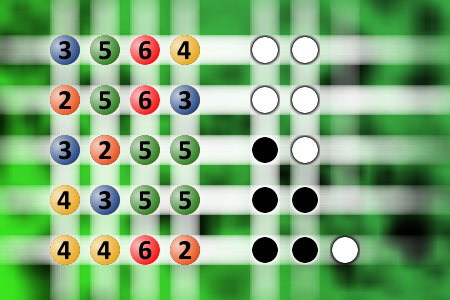
Which is a winning combination of digits?
[6659] Which is a winning combination of digits? - The computer chose a secret code (sequence of 4 digits from 1 to 6). Your goal is to find that code. Black circles indicate the number of hits on the right spot. White circles indicate the number of hits on the wrong spot. - #brainteasers #mastermind - Correct Answers: 15 - The first user who solved this task is Nasrin 24 T
BRAIN TEASERS
enter your answer and press button OK

Which is a winning combination of digits?

The computer chose a secret code (sequence of 4 digits from 1 to 6). Your goal is to find that code. Black circles indicate the number of hits on the right spot. White circles indicate the number of hits on the wrong spot.
Correct answers: 15
The first user who solved this task is Nasrin 24 T.
#brainteasers #mastermind
Register with your Google Account and start collecting points.
Check your ranking on list.

Olive

A blonde was hunched over the bar, toothpick in hand, spearing futilely at the olive in her drink. A dozen times the olive eluded her. Finally, another patron, who had been watching intently from the next stool, became exasperated and grabbed the toothpick.
"Here, this is how you do it." he said, as he easily skewered the olive.
"Big Deal," muttered the blonde. "I already had him so tired out, he couldn't get away."      

Jokes of the day - Daily updated jokes. New jokes every day.
Follow Brain Teasers on social networks

Brain Teasers

puzzles, riddles, mathematical problems, mastermind, cinemania...

Mercury capsule patent

In 1963, the Mercury space capsule was patented by Faget, Meyer, Chilton, Blanchard, Kehlet, Hammack and Johnson (U.S. No. 3,093,346). It was assigned to NASA. The invention was described as a "manned capsule configuration capable of being launched into orbital flight and returned to the earth's surface." The invention was to provide "protection for its occupant from the deleterious effects of large pressure differentials, high temperatures, micrometerorite collisions, high level acoustical noise, and severe inertial and impact loads." The patent was applied for on 6 Oct 1959. Mercury 1 had already flown, on 5 May 1961, in a 15-min sub-orbital flight carrying Alan B. Shepard before the patent was issued.
This site uses cookies to store information on your computer. Some are essential to help the site properly. Others give us insight into how the site is used and help us to optimize the user experience. See our privacy policy.