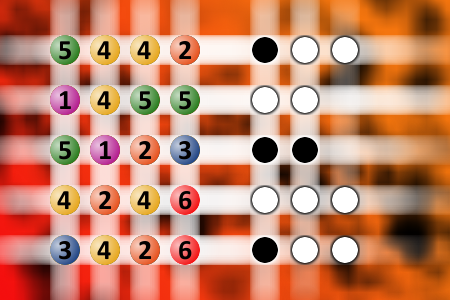
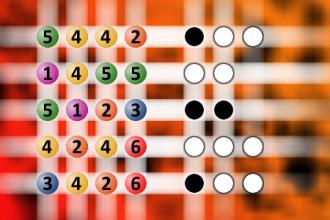
Which is a winning combination of digits?
[6713] Which is a winning combination of digits? - The computer chose a secret code (sequence of 4 digits from 1 to 6). Your goal is to find that code. Black circles indicate the number of hits on the right spot. White circles indicate the number of hits on the wrong spot. - #brainteasers #mastermind - Correct Answers: 16 - The first user who solved this task is Nasrin 24 T
BRAIN TEASERS
enter your answer and press button OK

Which is a winning combination of digits?

The computer chose a secret code (sequence of 4 digits from 1 to 6). Your goal is to find that code. Black circles indicate the number of hits on the right spot. White circles indicate the number of hits on the wrong spot.
Correct answers: 16
The first user who solved this task is Nasrin 24 T.
#brainteasers #mastermind

Register with your Google Account and start collecting points.
Check your ranking on list.

A pious man who had reached th...

A pious man who had reached the age of 105 suddenly stopped going to synagogue. Alarmed by the old fellow's absence after so many years of faithful attendance the Rabbi went to see him.
He found him in excellent health, so the Rabbi asked, "How come after all these years we don't see you at services anymore?"
The old man looked around and lowered his voice. "I'll tell you, Rabbi," he whispered. "When I got to be 90, I expected God to take me any day. But then I got to be 95, then 100, then 105. So I figured that God is very busy and must've forgotten about me, and I don't want to remind Him!"
Jokes of the day - Daily updated jokes. New jokes every day.
Follow Brain Teasers on social networks

Brain Teasers

puzzles, riddles, mathematical problems, mastermind, cinemania...

Samuel K. Hoffman

Died 26 Jun 1995 at age 93 (born 15 Apr 1902).Samuel Kurtz Hoffman was an American engineer who led the development of the liquid fuel rocket engines used in America's early space programs. His career began as an aeronautical-design engineer (1932-45) and then he spent four years teaching in that field. By 1949, he joined the Propulsion Section of North American Aviation which he later headed as its president (1960-70). (That division, renamed Rocketdyne, later became part of Rockwell International Corp.) He supervised the development of the first-stage Redstone propulsion system, which launched Explorer I, America's first satellite (31 Jan 1958). His work continued with the high-thrust engines used for the Mercury rockets that propelled the first U.S. astronauts into space, and the F-1 rocket engines used in the first stage of the Saturn V rockets of the Apollo moonshot program.«
This site uses cookies to store information on your computer. Some are essential to help the site properly. Others give us insight into how the site is used and help us to optimize the user experience. See our privacy policy.