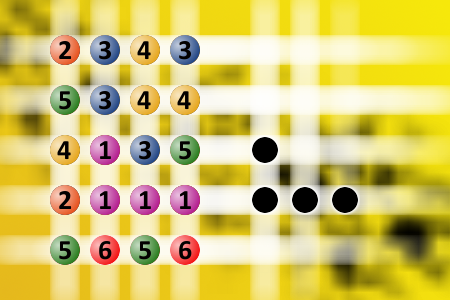
Which is a winning combination of digits?
[6877] Which is a winning combination of digits? - The computer chose a secret code (sequence of 4 digits from 1 to 6). Your goal is to find that code. Black circles indicate the number of hits on the right spot. White circles indicate the number of hits on the wrong spot. - #brainteasers #mastermind - Correct Answers: 28 - The first user who solved this task is Nasrin 24 T
BRAIN TEASERS
enter your answer and press button OK

Which is a winning combination of digits?

The computer chose a secret code (sequence of 4 digits from 1 to 6). Your goal is to find that code. Black circles indicate the number of hits on the right spot. White circles indicate the number of hits on the wrong spot.
Correct answers: 28
The first user who solved this task is Nasrin 24 T.
#brainteasers #mastermind
Register with your Google Account and start collecting points.
Check your ranking on list.

Christmas QA jokes part two

Q: What do you call a cat sitting on the beach on Christmas Eve?
A: Sandy Claws.

Q: Where does the snowman hide his money?
A: In the snow bank.

Q: What type of cars do elves drive?
A: Toy-otas.

Q: Why did the Christmas tree go to the barber?
A: It needed to be trimmed.

Q: What kind of motorcycle does Santa ride?
A: Holly Davidson.

Q: What do you call a bankrupt Santa?
A: Saint Nickel-less.

Jokes of the day - Daily updated jokes. New jokes every day.
Follow Brain Teasers on social networks

Brain Teasers

puzzles, riddles, mathematical problems, mastermind, cinemania...

Flashlight patent

In 1899, a U.S. patent was issued for an "Electric Device," invented by David Misell, which was manufactured as the first tubular "Flash Light" by Conrad Hubert at his American Electrical Novelty and Manufacturing Company (No. 617,592). The limited power of the batteries of the era could only power the inefficient carbon-filament miniature light bulb for brief periods of time between periods of recovery time. As batteries improved, it remained known as a "flashlight" in the U.S., but known as a torch in Britain. Misell was British, but lived in Manhattan, N.Y. at the time of the patent. His design had a tubular case, lens over a reflector and bulb at one end, an switch for intermittent use, used cylindrical batteries contained end-to-end in the now familiar manner, and a removable cap at the other end to insert them.[Image: Detail of head of the flashlight from cross-section patent drawing.]
This site uses cookies to store information on your computer. Some are essential to help the site properly. Others give us insight into how the site is used and help us to optimize the user experience. See our privacy policy.