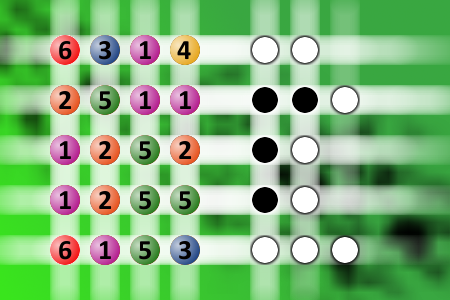
Which is a winning combination of digits?
[7058] Which is a winning combination of digits? - The computer chose a secret code (sequence of 4 digits from 1 to 6). Your goal is to find that code. Black circles indicate the number of hits on the right spot. White circles indicate the number of hits on the wrong spot. - #brainteasers #mastermind - Correct Answers: 17 - The first user who solved this task is Nasrin 24 T
BRAIN TEASERS
enter your answer and press button OK

Which is a winning combination of digits?

The computer chose a secret code (sequence of 4 digits from 1 to 6). Your goal is to find that code. Black circles indicate the number of hits on the right spot. White circles indicate the number of hits on the wrong spot.
Correct answers: 17
The first user who solved this task is Nasrin 24 T.
#brainteasers #mastermind
Register with your Google Account and start collecting points.
Check your ranking on list.

7 Funny short jokes to wake you up

We just watched the Tetris movie.
It's a blockbuster

My family is getting sick of me telling dad jokes 24/7.
Or should I say “they are sick of me telling dad jokes 3.428571428571429”?

When I was younger I had a job pretending to be a statue.
I held that position for some time.

The new thought-activated car they're working on is going to be even more popular than the voice-activated one.
It goes without saying.

My wife is one of the clumsiest people I know.
I'm so glad she fell for me

I have two questions about this Taylor Swift lady:
What kind of clothes does she make? And how fast does she make them, really?

I can’t think of a time when I lost my toupee while riding a motorcycle.
At least not right off the top of my head.

What do you call a 400 pound alcoholic?
A heavy drinker.

Jokes of the day - Daily updated jokes. New jokes every day.
Follow Brain Teasers on social networks

Brain Teasers

puzzles, riddles, mathematical problems, mastermind, cinemania...

Hans Spemann

Born 27 Jun 1869; died 12 Sep 1941 at age 72.German embryologist who was awarded the Nobel Prize for Physiology and Medicine (1935) for his discovery of embryonic induction, an effect involving several parts of the embryo in directing the development of the early group of cells into specific tissues and organs. Working extensively on the early development of the newt, he showed that the in the earliest stage, tissues may be transplanted to different areas of the embryo, and it then develops based on the new location and not from where it came. For example, early tissue cut from an area of nervous tissue might be moved to an area of skin tissue where it then grows into the same form as the surrounding skin.
This site uses cookies to store information on your computer. Some are essential to help the site properly. Others give us insight into how the site is used and help us to optimize the user experience. See our privacy policy.