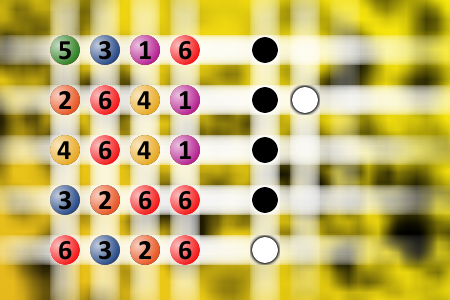
Which is a winning combination of digits?
[7557] Which is a winning combination of digits? - The computer chose a secret code (sequence of 4 digits from 1 to 6). Your goal is to find that code. Black circles indicate the number of hits on the right spot. White circles indicate the number of hits on the wrong spot. - #brainteasers #mastermind - Correct Answers: 3
BRAIN TEASERS
enter your answer and press button OK

Which is a winning combination of digits?

The computer chose a secret code (sequence of 4 digits from 1 to 6). Your goal is to find that code. Black circles indicate the number of hits on the right spot. White circles indicate the number of hits on the wrong spot.
Correct answers: 3
#brainteasers #mastermind
Register with your Google Account and start collecting points.
Check your ranking on list.

A sister and brother are talki...

A sister and brother are talking to each other when the little boy gets up and walks over to his Grandpa and says, "Grandpa, please make a frog noise."
The Grandpa says, "No."
The little boy goes on, "Please .. please make a frog noise."
The Grandpa says, "No, now go play."
The little boy then says to his sister, "Go tell Grandpa to make a frog noise."
So the little girl goes to her Grandpa and says, "Please make a frog noise."
The Grandpa says, "I just told your brother 'no' and I'm telling you 'no'." The little girl says, "Please .. please Grandpa make a frog noise." The Grandpa says, "Why do you want me to make a frog noise?"
The little girl replied, "Because mommy said when you croak we can go to Disney World!"
Jokes of the day - Daily updated jokes. New jokes every day.
Follow Brain Teasers on social networks

Brain Teasers

puzzles, riddles, mathematical problems, mastermind, cinemania...

Marvin Minsky

Born 9 Aug 1927. American biochemist and the founder of the MIT Artificial Intelligence Project. Marvin Minsky has made many contributions to AI, cognitive psychology, mathematics, computational linguistics, robotics, and optics. He holds several patents, including those for the first neural-network simulator (SNARC, 1951), the first head-mounted graphical display, the first confocal scanning microscope, and the LOGO "turtle" device. His other inventions include mechanical hands and the "Muse" synthesizer for musical variations (with E. Fredkin). In recent years he has worked chiefly on imparting to machines the human capacity for commonsense reasoning.
This site uses cookies to store information on your computer. Some are essential to help the site properly. Others give us insight into how the site is used and help us to optimize the user experience. See our privacy policy.