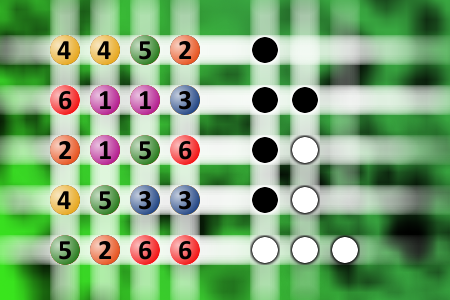
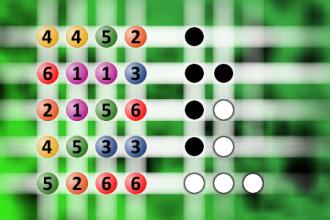
Which is a winning combination of digits?
[7665] Which is a winning combination of digits? - The computer chose a secret code (sequence of 4 digits from 1 to 6). Your goal is to find that code. Black circles indicate the number of hits on the right spot. White circles indicate the number of hits on the wrong spot. - #brainteasers #mastermind - Correct Answers: 4
BRAIN TEASERS
enter your answer and press button OK

Which is a winning combination of digits?

The computer chose a secret code (sequence of 4 digits from 1 to 6). Your goal is to find that code. Black circles indicate the number of hits on the right spot. White circles indicate the number of hits on the wrong spot.
Correct answers: 4
#brainteasers #mastermind
Register with your Google Account and start collecting points.
Check your ranking on list.

Texas

At the urging of his doctor, Bill moved to Texas.

After settling in, he met a neighbor who was also an older man.

“Say, is this really a healthy place?”

“It sure is,” the man replied.

“When I first arrived here I couldn't say one word. I had hardly any hair on my head. I didn't have the strength to walk across a room and I had to be lifted out of bed.”

“That's wonderful!” said Bill. “How long have you been here?”

“I was born here.”

Jokes of the day - Daily updated jokes. New jokes every day.
Follow Brain Teasers on social networks

Brain Teasers

puzzles, riddles, mathematical problems, mastermind, cinemania...

Earliest U.S. celestial photograph

In 1839, John William Draper took a daguerreotype of the moon, the first celestial photograph made in the U.S. He exposed the plate for 20 minutes using a 5-inch telescope and produced an image one inch in diameter. Draper was a professor of chemistry at New York University, New York City. His research in the effect of light upon chemicals had led him to take up photography. He also made his first satisfactory photographic portrait in 1839. A picture he took (1840) of his sister is the oldest surviving photographic portrait. Draper made important scientific contributions in fields of radiant energy, photochemistry, photography, and electric telegraphy. He also anticipated development of spectrum analysis.
This site uses cookies to store information on your computer. Some are essential to help the site properly. Others give us insight into how the site is used and help us to optimize the user experience. See our privacy policy.