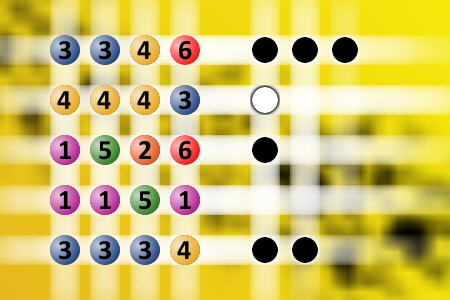
Which is a winning combination of digits?
[7693] Which is a winning combination of digits? - The computer chose a secret code (sequence of 4 digits from 1 to 6). Your goal is to find that code. Black circles indicate the number of hits on the right spot. White circles indicate the number of hits on the wrong spot. - #brainteasers #mastermind - Correct Answers: 5
BRAIN TEASERS
enter your answer and press button OK

Which is a winning combination of digits?

The computer chose a secret code (sequence of 4 digits from 1 to 6). Your goal is to find that code. Black circles indicate the number of hits on the right spot. White circles indicate the number of hits on the wrong spot.
Correct answers: 5
#brainteasers #mastermind
Register with your Google Account and start collecting points.
Check your ranking on list.

Jacob, age 92, and Rebecca, ag...

Jacob, age 92, and Rebecca, age 89, living in Florida, are all excited about their decision to get married. They go for a stroll to discuss the wedding, and on the way they pass a drugstore. Jacob suggests they go in.
Jacob addresses the man behind the counter: Are you the owner?
The pharmacist answers, Yes.
Jacob: Were about to get married. Do you sell heart medication?
Pharmacist: Of course we do.
Jacob: How about medicine for circulation?
Pharmacist: All kinds.
Jacob: Medicine for rheumatism and scoliosis?
Pharmacist: Definitely.
Jacob: How about Viagra?
Pharmacist: Of course.
Jacob: Medicine for memory problems, arthritis, jaundice?
Pharmacist: Yes, a large variety. The works.
Jacob: What about vitamins, sleeping pills, Geritol, antidotes for Parkinsons disease?
Pharmacist: Absolutely.
Jacob: You sell wheelchairs and walkers?
Pharmacist: All speeds and sizes.
Jacob: We would like to use this store as our Bridal Registry.
Jokes of the day - Daily updated jokes. New jokes every day.
Follow Brain Teasers on social networks

Brain Teasers

puzzles, riddles, mathematical problems, mastermind, cinemania...

Andrey Andreyevich Markov

Born 14 Jun 1856; died 20 Jul 1922 at age 66.Russian mathematician who helped to develop the theory of stochastic processes, especially those called Markov chains, sequences of random variables in which the future variable is determined by the present variable but is independent of the way in which the present state arose from its predecessors. (For example, the probability of winning at the game of Monopoly can be determined using Markov chains.) His work based on the study of the probability of mutually dependent events has been developed and widely applied to the biological and social sciences.
This site uses cookies to store information on your computer. Some are essential to help the site properly. Others give us insight into how the site is used and help us to optimize the user experience. See our privacy policy.