
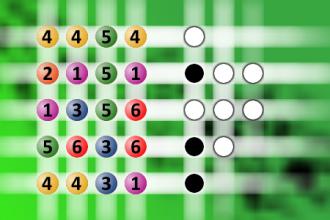
Which is a winning combination of digits?
[7811] Which is a winning combination of digits? - The computer chose a secret code (sequence of 4 digits from 1 to 6). Your goal is to find that code. Black circles indicate the number of hits on the right spot. White circles indicate the number of hits on the wrong spot. - #brainteasers #mastermind - Correct Answers: 2
BRAIN TEASERS
enter your answer and press button OK

Which is a winning combination of digits?

The computer chose a secret code (sequence of 4 digits from 1 to 6). Your goal is to find that code. Black circles indicate the number of hits on the right spot. White circles indicate the number of hits on the wrong spot.
Correct answers: 2
#brainteasers #mastermind
Register with your Google Account and start collecting points.
Check your ranking on list.

Little Johnny is taking a show...

Little Johnny is taking a shower with his mother and says, "Mom, what are those things on your chest!?" Unsure of how to reply, she tells Johnny to ask his dad at breakfast tomorrow, quite certain the matter would be forgotten.

Johnny didn't forget. The following morning he asked his father the same question. His father, always quick with the answers, says, "Why Johnny, those are balloons. When your mommy dies, we can blow them up and she'll float to heaven." Johnny thinks that's neat and asks no more questions.

A few weeks later, Johnnys' dad comes home from work a few hours early. Johnny runs out of the house crying hysterically, "Daddy! Daddy! Mommy's dying!!"

His father says, "Calm down son! Why do you think Mommy's dying?"

"Uncle Harry is blowing up Mommys' balloons and she's screaming, "Oh God, I'm coming!"
Jokes of the day - Daily updated jokes. New jokes every day.
Follow Brain Teasers on social networks

Brain Teasers

puzzles, riddles, mathematical problems, mastermind, cinemania...

Sir Isaac Shoenberg

Died 25 Jan 1963 at age 82 (born 1 Mar 1880).Russian-Born British electrical engineer and principal inventor of the first high-definition television system, as used by the British Broadcasting Corporation (BBC) for the world's first public high-definition telecast (from London, 1936). He had installed the first radio stations in Russia before moving to England in 1914. He was head of a research group for Electrical and Musical Industries (EMI) that developed (1931-35) an advanced kind of camera tube (the Emitron) and a relatively efficient hard-vacuum cathode-ray tube for the television receiver. Until 1964 the BBC used his technical standard proposal - 405 scanning lines and 25 pictures a second. He was director of EMI from 1955. His youngest son, David Shoenberg, became a noted physicist.
This site uses cookies to store information on your computer. Some are essential to help the site properly. Others give us insight into how the site is used and help us to optimize the user experience. See our privacy policy.