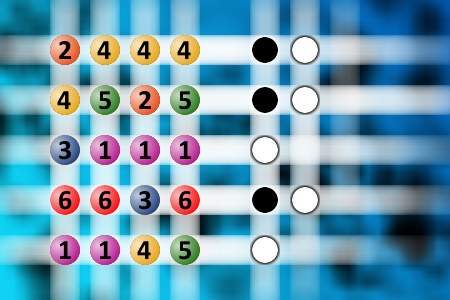
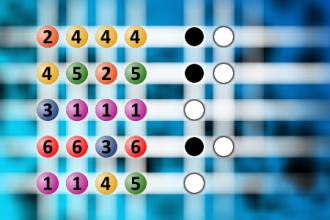
Which is a winning combination of digits?
[7862] Which is a winning combination of digits? - The computer chose a secret code (sequence of 4 digits from 1 to 6). Your goal is to find that code. Black circles indicate the number of hits on the right spot. White circles indicate the number of hits on the wrong spot. - #brainteasers #mastermind - Correct Answers: 5
BRAIN TEASERS
enter your answer and press button OK

Which is a winning combination of digits?

The computer chose a secret code (sequence of 4 digits from 1 to 6). Your goal is to find that code. Black circles indicate the number of hits on the right spot. White circles indicate the number of hits on the wrong spot.
Correct answers: 5
#brainteasers #mastermind
Register with your Google Account and start collecting points.
Check your ranking on list.

Gallery Sale

An artist asked the gallery owner if there had been any interest in her paintings that were on display.
"Well, I have good news and bad news," the owner responded. "The good news is that a gentleman noticed your work and wondered if it would appreciate in value after your death. I told him it would and he bought all 10 of your paintings."
"That's wonderful," the artist exclaimed. "What's the bad news?"
"The gentleman was your doctor."

Jokes of the day - Daily updated jokes. New jokes every day.
Follow Brain Teasers on social networks

Brain Teasers

puzzles, riddles, mathematical problems, mastermind, cinemania...

John Henry Poynting

Born 9 Sep 1852; died 30 Mar 1914 at age 61.British physicist who introduced a theorem (1884-85) that assigns a value to the rate of flow of electromagnetic energy known as the Poynting vector, introduced in his paper On the Transfer of Energy in the Electromagnetic Field (1884). In this he showed that the flow of energy at a point can be expressed by a simple formula in terms of the electric and magnetic forces at that point. He determined the mean density of the Earth (1891) and made a determination of the gravitational constant (1893) using accurate torsion balances. He was also the first to suggest, in 1903, the existence of the effect of radiation from the Sun that causes smaller particles in orbit about the Sun to spiral close and eventually plunge in.
This site uses cookies to store information on your computer. Some are essential to help the site properly. Others give us insight into how the site is used and help us to optimize the user experience. See our privacy policy.