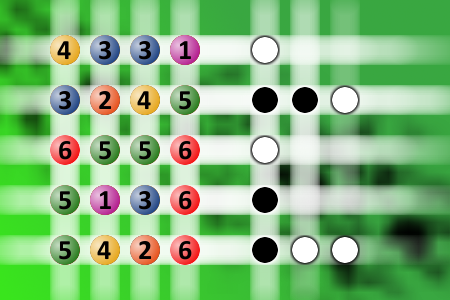
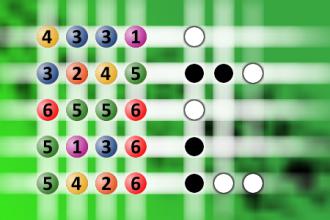
Which is a winning combination of digits?
[7998] Which is a winning combination of digits? - The computer chose a secret code (sequence of 4 digits from 1 to 6). Your goal is to find that code. Black circles indicate the number of hits on the right spot. White circles indicate the number of hits on the wrong spot. - #brainteasers #mastermind - Correct Answers: 1
BRAIN TEASERS
enter your answer and press button OK

Which is a winning combination of digits?

The computer chose a secret code (sequence of 4 digits from 1 to 6). Your goal is to find that code. Black circles indicate the number of hits on the right spot. White circles indicate the number of hits on the wrong spot.
Correct answers: 1
#brainteasers #mastermind
Register with your Google Account and start collecting points.
Check your ranking on list.

The Typewriter

They had been up in the attic together doing some cleaning. The kids uncovered an old manual typewriter and asked, 'Hey Mom, what's this?'
'Oh, that's an old typewriter,' she answered, thinking that would satisfy their curiosity.
'Well what does it do?' they asked.
'I'll show you,' she said and returned with a blank piece of paper. She rolled the paper into the typewriter and began striking the keys, leaving black letters of print on the page.
'WOW!' they exclaimed, 'That's really cool.! But how does it work like that? Where do you plug it in?'
'There is no plug,' she answered. 'It doesn't need a plug.'
'Then where do you put the batteries?' they persisted.
'It doesn't need batteries either.' she continued.
'Wow! This is so cool!' they exclaimed. 'Someone should have invented this a long time ago!'

Jokes of the day - Daily updated jokes. New jokes every day.
Follow Brain Teasers on social networks

Brain Teasers

puzzles, riddles, mathematical problems, mastermind, cinemania...

Reading for the blind

In 1976, the first machine for reading printed matter aloud was given its first public demonstration, by its inventor, Raymond Kurzwell. Using a camera with a computer, pages of printed matter could be scanned, the letters analysed, and reproduced in synthesized English speech at 150 words per minute. The material used could be books, magazines or typewritten correspondence. The machine was manufactured by the Kurzwell Computer Products, Inc., and was tested by the National Federation for the Blind.
This site uses cookies to store information on your computer. Some are essential to help the site properly. Others give us insight into how the site is used and help us to optimize the user experience. See our privacy policy.