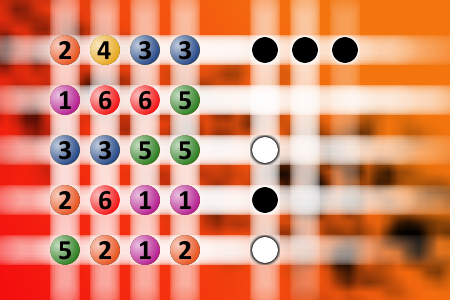
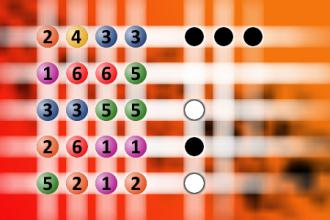
Which is a winning combination of digits?
[8398] Which is a winning combination of digits? - The computer chose a secret code (sequence of 4 digits from 1 to 6). Your goal is to find that code. Black circles indicate the number of hits on the right spot. White circles indicate the number of hits on the wrong spot. - #brainteasers #mastermind - Correct Answers: 0
BRAIN TEASERS
enter your answer and press button OK

Which is a winning combination of digits?

The computer chose a secret code (sequence of 4 digits from 1 to 6). Your goal is to find that code. Black circles indicate the number of hits on the right spot. White circles indicate the number of hits on the wrong spot.
Correct answers: 0
#brainteasers #mastermind
Register with your Google Account and start collecting points.
Check your ranking on list.

Playing Your Age

A lady is having a bad day at the roulette tables in Vegas. She's down to her last $50. Exasperated, she exclaims to the whole table, 'What rotten luck I've had today! What in the world should I do now?'
A man standing next to her suggests, 'I don't know, why don't you play your age?'
He walks away, but moments later, his attention is grabbed by a great commotion at the roulette table. Maybe she won! He rushes back to the table and pushes his way through the crowd. The lady is lying limp on the floor, with the table operator kneeling over her. The man is stunned. He asks, 'What happened? Is she all right?'
The operator replies, 'I don't know. She put all her money on 36, and when 47 came up she just fainted!'

Jokes of the day - Daily updated jokes. New jokes every day.
Follow Brain Teasers on social networks

Brain Teasers

puzzles, riddles, mathematical problems, mastermind, cinemania...

Edison patent

In 1882, Thomas A. Edison was issued a patent for an improvement to the telephone (No. 252,442). It described a carbon microphone. Finely divided conducting material, such as carbon, between metal cups mounted on arms is attached to the mouthpiece diaphragm. As sound waves directed through the mouthpiece move the diaphragm, the arms change the pressure on the carbon button which in turn varies an electric current passing through the carbon button. Changes in the current correspond to the pitch and amplitude of the sound. One arm conducts the electrical current to the carbon button, and the the other from it.
This site uses cookies to store information on your computer. Some are essential to help the site properly. Others give us insight into how the site is used and help us to optimize the user experience. See our privacy policy.