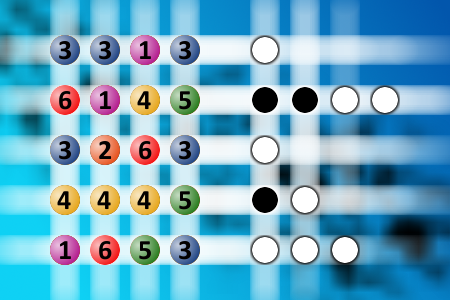

Which is a winning combination of digits?
[8536] Which is a winning combination of digits? - The computer chose a secret code (sequence of 4 digits from 1 to 6). Your goal is to find that code. Black circles indicate the number of hits on the right spot. White circles indicate the number of hits on the wrong spot. - #brainteasers #mastermind - Correct Answers: 1
BRAIN TEASERS
enter your answer and press button OK

Which is a winning combination of digits?

The computer chose a secret code (sequence of 4 digits from 1 to 6). Your goal is to find that code. Black circles indicate the number of hits on the right spot. White circles indicate the number of hits on the wrong spot.
Correct answers: 1
#brainteasers #mastermind
Register with your Google Account and start collecting points.
Check your ranking on list.

Low Bridge

A truck driver was driving along on the freeway. He passed a sign that said “low bridge ahead.”
Before he knew it, the bridge was right ahead of him and he got stuck under the bridge. You could say that he got a rock solid “Trucker’s Wedgie.”
Cars were backed up for miles.
Finally, a police car pulled up. The cop got out of his car and walked around to the truck driver, put his hands on his hips and said, “Got stuck, huh?”
The truck driver said, “No officer,… I was delivering this bridge and ran out of gas!”

Jokes of the day - Daily updated jokes. New jokes every day.
Follow Brain Teasers on social networks

Brain Teasers

puzzles, riddles, mathematical problems, mastermind, cinemania...

Clock patent

In 1797, the first patent in the U.S. for a clock was issued to Eli Terry of East Windsor, Conn. for an equation clock. The clock had two minute hands, one of which showed the mean or true time, while the other "together with the striking part and hour hand showed the apparent time, as divided by the sun according to the table of variation of the sun and clock for each day of the year." He began making clocks in 1793, in Plymouth, Conn. Terry introduced wooden geared clocks using the ideas of Eli Whitney's new armory practice to produce interchangeable gears (1802) and mass production of very inexpensive household clocks. Terry developed ways to produce wooden clock works by machine.
This site uses cookies to store information on your computer. Some are essential to help the site properly. Others give us insight into how the site is used and help us to optimize the user experience. See our privacy policy.