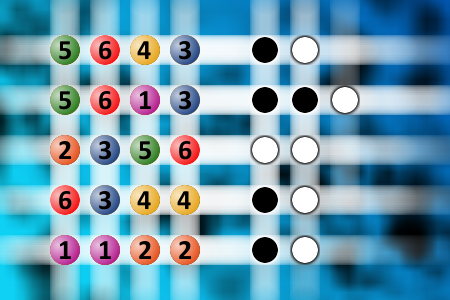
Which is a winning combination of digits?
[8758] Which is a winning combination of digits? - The computer chose a secret code (sequence of 4 digits from 1 to 6). Your goal is to find that code. Black circles indicate the number of hits on the right spot. White circles indicate the number of hits on the wrong spot. - #brainteasers #mastermind - Correct Answers: 0
BRAIN TEASERS
enter your answer and press button OK

Which is a winning combination of digits?

The computer chose a secret code (sequence of 4 digits from 1 to 6). Your goal is to find that code. Black circles indicate the number of hits on the right spot. White circles indicate the number of hits on the wrong spot.
Correct answers: 0
#brainteasers #mastermind
Register with your Google Account and start collecting points.
Check your ranking on list.

The Blessing – You may have lived this one

Joan invited some people to dinner. At the table, she turned to her six-year-old daughter and said, 'Would you like to say the blessing?'
'I wouldn't know what to say,' the girl replied.
'Just say what you hear Mommy say,' Joan answered.
The girl thought for a minute, then bowed her head and said, 'Lord, why on earth did I invite all these people to dinner?'

Jokes of the day - Daily updated jokes. New jokes every day.
Follow Brain Teasers on social networks

Brain Teasers

puzzles, riddles, mathematical problems, mastermind, cinemania...

Thomas Edward Allibone

Born 11 Nov 1903; died 9 Sep 2003 at age 99.English physicist who was a leading authority on high-voltage physics, a member of the Anglo-American team that worked on the atomic bomb, and the last surviving direct colleague of Ernest Rutherford, the father of nuclear physics. Allibone proposed to Rutherford that he could build a powerful generator to provide the huge voltages needed artificially to accelerate electrons in a vacuum tube. By 1927, Allibone had built the Voltage Doubler, a device in which electrons and atoms could be accelerated at high speeds, which was used by Rutherford and his team in their subsequent researches on particle acceleration. In 1944 he joined the British team working on the Manhattan project to build the atomic bomb in Berkeley, Cal., and Oak Ridge, Tenn.
This site uses cookies to store information on your computer. Some are essential to help the site properly. Others give us insight into how the site is used and help us to optimize the user experience. See our privacy policy.