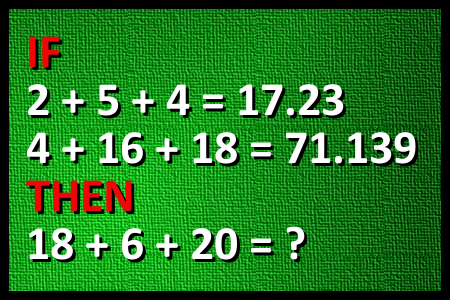
Calculate 18+6+20
[255] Calculate 18+6+20 - FUNNY MATH: Calculate 18+6+20 (Author: Ruzica Pavlovic) - #brainteasers #math - Correct Answers: 25 - The first user who solved this task is Sanja Šabović
BRAIN TEASERS
enter your answer and press button OK

Calculate 18+6+20

FUNNY MATH: Calculate 18+6+20 (Author: Ruzica Pavlovic)
Correct answers: 25
The first user who solved this task is Sanja Šabović.
#brainteasers #math
Register with your Google Account and start collecting points.
Check your ranking on list.

Cowboy without a horse

A cowboy rode into town and stopped at a saloon for a drink. Unfortunately, the locals always had a habit of picking on strangers, which he was. When he finished his drink, he found his horse had been stolen.

He goes back into the bar, handily flips his gun into the air, catches it above his head without even looking and fires a shot into the ceiling.

"WHICH ONE OF YOU SIDEWINDERS STOLE MY HORSE?" he yelled with surprising forcefulness. No one answered.

"ALL RIGHT, I'M GONNA HAVE ANOTHER BEER, AND IF MY HOSS AIN'T BACK OUTSIDE BY THE TIME I FINNISH, I'M GONNA DO WHAT I DUN IN TEXAS! AND I DON'T LIKE TO HAVE TO DO WHAT I DUN IN TEXAS!"

Some of the locals shifted restlessly. He had another beer, walked outside, and his horse is back! He saddles-up and starts to ride out of town. The bartender wanders out of the bar and asks, "Say partner, before you go...what happened in Texas?"

The cowboy turned back and said, "I had to walk home."

Jokes of the day - Daily updated jokes. New jokes every day.
Follow Brain Teasers on social networks

Brain Teasers

puzzles, riddles, mathematical problems, mastermind, cinemania...

Moon radar

In 1946, the U.S. Army Project Diana team detected radar signals reflected off the moon's surface. A 180 cycle wave pulse with a 1/4 sec duration was beamed by the Army Signal Corps from the Evans Signal Laboratories, Belmar, N.J. The echo was received 2.4 sec. later, proving that radio waves could penetrate Earth's atmosphere. The experiment was supervised by Lt. Col. John H. De Witt, the broadcasting pioneer and amateur astronomer who first came up with the idea in 1940. His early amateur attempts were unsuccessful, but his chance came a few years later, after WW II, courtesy of the U.S. Army, at the Signal Corps Laboratories. During the war, he had developed radar for locating mortars and directing counterfire.«[Image: A wartime SCR-271 bedspring radar antenna, greatly modified for use in the experiment.]
This site uses cookies to store information on your computer. Some are essential to help the site properly. Others give us insight into how the site is used and help us to optimize the user experience. See our privacy policy.