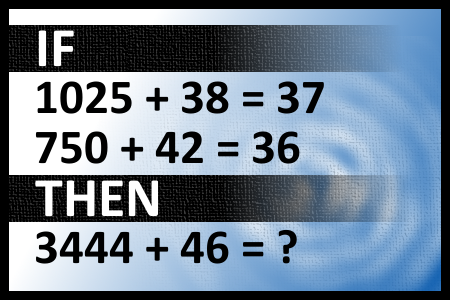
Calculate 3444+46
[140] Calculate 3444+46 - FUNNY MATH: Calculate 3444+46 :) - #brainteasers #math - Correct Answers: 63 - The first user who solved this task is Sanja Šabović
BRAIN TEASERS
enter your answer and press button OK

Calculate 3444+46

FUNNY MATH: Calculate 3444+46 :)
Correct answers: 63
The first user who solved this task is Sanja Šabović.
#brainteasers #math
Register with your Google Account and start collecting points.
Check your ranking on list.

Disappearing diner

A man and a beautiful woman were having dinner in a fine restaurant. Their waitress, taking another order at a table a few paces away suddenly noticed that the man was slowing sliding down his chair and under the table, but the woman acted unconcerned. The waitress watched as the man slid all the way down his chair and out of sight under the table. Still, the woman dining across from him appeared calm and unruffled, apparently unaware that her dining companion had disappeared.

After the waitress finished taking the order, she came over to the table and said to the woman, "Pardon me, ma'am, but I think your husband just slid under the table." The woman calmly looked up at her and replied firmly, "No he didn't. My husband just walked in the door."

Jokes of the day - Daily updated jokes. New jokes every day.
Follow Brain Teasers on social networks

Brain Teasers

puzzles, riddles, mathematical problems, mastermind, cinemania...

Julian Lowell Coolidge

Born 28 Sep 1873; died 5 Mar 1954 at age 80. American mathematician and educator noted for numerous published works in theoretical mathematics. He earned a B.A. degree at Harvard (1895), then a B.Sc. (1897) from Oxford, England, the first natural science degree ever awarded at Oxford. He began teaching at Groton School, Conn. (1897-99) where one of his pupils was Franklin D Roosevelt, the future U.S. president. Coolidge was an instructor at Harvard University, taking leave to study abroad (1902-04) with Corrado Segre at Turin and Eduard Studyat the University of Bonn ( Ph.D. 1904). When he returned to Harvard, he remained there for the rest of his career. Later in life, he took an interest in his subject's history, writing Mathematics of the Great Amateurs (1949).«
This site uses cookies to store information on your computer. Some are essential to help the site properly. Others give us insight into how the site is used and help us to optimize the user experience. See our privacy policy.