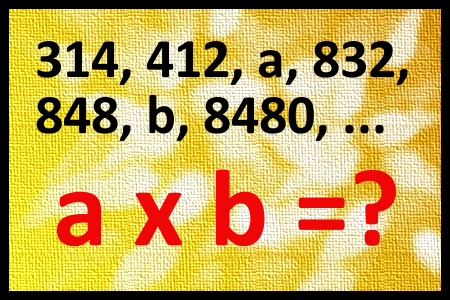
Calculate axb
[298] Calculate axb - Look at the series (314, 412, a, 832, 848, b, 8480), determine the pattern, and calculate axb. - #brainteasers #math - Correct Answers: 34 - The first user who solved this task is Sanja Šabović
BRAIN TEASERS
enter your answer and press button OK

Calculate axb

Look at the series (314, 412, a, 832, 848, b, 8480), determine the pattern, and calculate axb.
Correct answers: 34
The first user who solved this task is Sanja Šabović.
#brainteasers #math
Register with your Google Account and start collecting points.
Check your ranking on list.

A tourist, visiting a small to...

A tourist, visiting a small town in Israel, came upon a statue dedicated to "The Unknown Soldier". At the base of the statue, a sign was displayed: "Here lies Seymour Ruthenberg".
The tourist inquired of one of the locals how was it possible an unknown had a name.
The resident replied, "As a soldier, that Seymour was pretty much unknown, but as an accountant - Oy! He was something."
Jokes of the day - Daily updated jokes. New jokes every day.
Follow Brain Teasers on social networks

Brain Teasers

puzzles, riddles, mathematical problems, mastermind, cinemania...

Robert Livingston Stevens

Born 18 Oct 1787; died 20 Apr 1856 at age 68.U.S. engineer and ship designer who invented the inverted-T railroad rail and the railroad spike. He tested the first steamboat to use screw propellers, invented and built by his father, John Stevens. Robert designed the first concave waterlines on a steamboat (1808), the first supporting iron rods for projecting guard beams on steamboats (1815), the first skeleton walking beams for ferries (1822), the spring pile ferry slip (1822), the placement of boilers on guards outside the paddle wheels of ferries (1822), the hog frame or truss for stiffening ferry boats longitudinally (1827), spring steel bearings of paddle wheel shafts (1828), improved packing for pistons (1840), and was first to successfully burn anthracite coal in a cupola furnace (1818). He found that rails laid on wooden ties, with crushed stone or gravel beneath, provided a roadbed superior to any known before. His rail and roadbed came into universal use in the United States. He also added the pilot, or cowcatcher, to the locomotive and increased the number of drive wheels to eight for better traction.
This site uses cookies to store information on your computer. Some are essential to help the site properly. Others give us insight into how the site is used and help us to optimize the user experience. See our privacy policy.