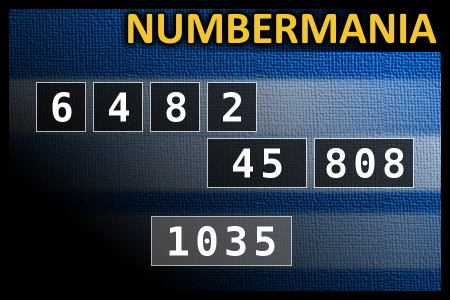
Calculate the number 1035
[973] Calculate the number 1035 - NUMBERMANIA: Calculate the number 1035 using numbers [6, 4, 8, 2, 45, 808] and basic arithmetic operations (+, -, *, /). Each of the numbers can be used only once. - #brainteasers #math #numbermania - Correct Answers: 24 - The first user who solved this task is Sanja Šabović
BRAIN TEASERS
enter your answer and press button OK

Calculate the number 1035

NUMBERMANIA: Calculate the number 1035 using numbers [6, 4, 8, 2, 45, 808] and basic arithmetic operations (+, -, *, /). Each of the numbers can be used only once.
Correct answers: 24
The first user who solved this task is Sanja Šabović.
#brainteasers #math #numbermania
Register with your Google Account and start collecting points.
Check your ranking on list.

Big People Words

A group of kindergartners were trying to become accustomed to the first grade. The biggest hurdle they faced was that the teacher insisted on no baby talk.
"You need to use 'big people' words," she'd always remind them. She asked Chris what he had done over the weekend. "I went to visit my Nana."
"No, you went to visit your GRANDMOTHER. Use big people words!" She then asked Mitchell what he had done. "I took a ride on a choo-choo."
She said, "No, you took a ride on a TRAIN. Use big people words." She then asked Bobby what he had done. "I read a book," he replied.

"That's WONDERFUL!" the teacher said. "What book did you read?" Bobby thought about it, then puffed out his little chest with great pride and said, "Winnie the Shit."

Jokes of the day - Daily updated jokes. New jokes every day.
Follow Brain Teasers on social networks

Brain Teasers

puzzles, riddles, mathematical problems, mastermind, cinemania...

Alan G. MacDiarmid

Born 14 Apr 1927; died 7 Feb 2007 at age 79.Alan Graham MacDiarmid was a New Zealand-American chemist whosharedthe 2000 Nobel Prize in Chemistry (with Alan Heeger and Hideki Shirakawa) “for the discovery and development of conductive polymers.”Plastics (formed of repeated units in long-chain polymer molecules) most often do not conduct electricity, and are used for insulation. At the end of the 1970's, these scientists devised polymer materials that were semi-conductors, able to conduct electricity. Practical applications now include conductive polymers in “smart”windows able to exclude sunlight, light-emitting diodes, solar cells and displays for mobile telephones and small television screens. Research has been stimulated to attempt to produce transistors consisting of individual molecules with which to dramatically reduce the size of computers.«
This site uses cookies to store information on your computer. Some are essential to help the site properly. Others give us insight into how the site is used and help us to optimize the user experience. See our privacy policy.