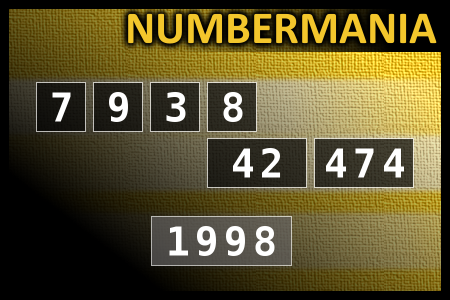
Calculate the number 1998
[1460] Calculate the number 1998 - NUMBERMANIA: Calculate the number 1998 using numbers [7, 9, 3, 8, 42, 474] and basic arithmetic operations (+, -, *, /). Each of the numbers can be used only once. - #brainteasers #math #numbermania - Correct Answers: 20 - The first user who solved this task is Sanja Šabović
BRAIN TEASERS
enter your answer and press button OK

Calculate the number 1998

NUMBERMANIA: Calculate the number 1998 using numbers [7, 9, 3, 8, 42, 474] and basic arithmetic operations (+, -, *, /). Each of the numbers can be used only once.
Correct answers: 20
The first user who solved this task is Sanja Šabović.
#brainteasers #math #numbermania
Register with your Google Account and start collecting points.
Check your ranking on list.

The Worst Age

"Sixty is the worst age to be," said the 60-year-old.
"You always feel like you have to pee. And most of the time, you stand at the toilet and nothing comes out!"
"Ah, that's nothin'," said the 70-year-old. "When you're seventy, you can't even crap anymore. You take laxatives, then you sit on the toilet all day and nothin' comes out!"
"Actually," said the 80-year-old, "80 is the worst age of all!"
"Do you have trouble peeing too?" asked the 60-year-old.
"No, not really. I pee every morning at 6:00. I pee like a racehorse on a flat rock; no problem at all."
"Do you have trouble crapping?" asked the 70-year-old.
"No, I crap every morning at 6:30."
With great exasperation, the 60-year-old said, "Let me get this straight. You pee every morning at 6:00 and crap every morning at 6:30.
So what's so tough about being 80?"

"I don't wake up until 7:00!"

Jokes of the day - Daily updated jokes. New jokes every day.
Follow Brain Teasers on social networks

Brain Teasers

puzzles, riddles, mathematical problems, mastermind, cinemania...

Barbara McClintock

Died 3 Sep 1992 at age 90 (born 16 Jun 1902). American scientist regarded as one of the most important figures in the history of genetics. In the 1940s and 1950s McClintock's work on the cytogenetics of maize led her to theorize that genes are transposable - they can move around - on and between chromosomes. McClintock drew this inference by observing changing patterns of coloration in maize kernels over generations of controlled crosses. The idea that genes could move did not seem to fit with what was then known about genes, but improved molecular techniques of the late 1970s and early 1980s allowed other scientists to confirm her discovery. She was awarded the 1983 Nobel Prize in Physiology or Medicine, the first American woman to win an unshared Nobel Prize.
This site uses cookies to store information on your computer. Some are essential to help the site properly. Others give us insight into how the site is used and help us to optimize the user experience. See our privacy policy.