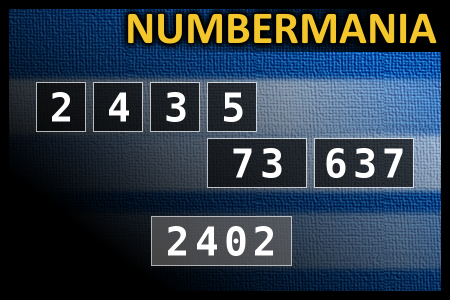
Calculate the number 2402
[675] Calculate the number 2402 - NUMBERMANIA: Calculate the number 2402 using numbers [2, 4, 3, 5, 73, 637] and basic arithmetic operations (+, -, *, /). Each of the numbers can be used only once. - #brainteasers #math #numbermania - Correct Answers: 32 - The first user who solved this task is Sanja Šabović
BRAIN TEASERS
enter your answer and press button OK

Calculate the number 2402

NUMBERMANIA: Calculate the number 2402 using numbers [2, 4, 3, 5, 73, 637] and basic arithmetic operations (+, -, *, /). Each of the numbers can be used only once.
Correct answers: 32
The first user who solved this task is Sanja Šabović.
#brainteasers #math #numbermania
Register with your Google Account and start collecting points.
Check your ranking on list.

Martha Kelly: Preparing for Office Work

Its been a couple of years since I actually worked in an office, so I thought I should do something to prepare to get back into the typing, filing and phone answering, and what not. So what I did was I had a friend of mine go with me down to the local swimming pool, and I had him tie me up in a burlap sack and sink me to the bottom of the pool. And then just as I was about to suffocate, he yanked me up and gave me a lunch break.
Jokes of the day - Daily updated jokes. New jokes every day.
Follow Brain Teasers on social networks

Brain Teasers

puzzles, riddles, mathematical problems, mastermind, cinemania...

Martin Heinrich Klaproth

Died 1 Jan 1817 at age 73 (born 1 Dec 1743). German chemist, who as a founder of analytical chemistry discovered uranium (1789), zirconium (1789), cerium (1803), and contributed to the identification of others. Although he did not isolate them as pure metal samples, he was able to recognize them as new elements. He apprenticed at age 16, to an apothecary. After reading chemistry at Hanover, he settled in Berlin (1771) and started his own apothecary shop (1780). By the late 1780, he was Europe's leading analytical chemist. Klaproth found ways of treating particularly insoluble compounds, took care to avoid contamination from his apparatus, and significantly insisted on reporting "small" weight discrepancies in analytical work as consistent results. He spread the ideas of Antoine Lavoisier.
This site uses cookies to store information on your computer. Some are essential to help the site properly. Others give us insight into how the site is used and help us to optimize the user experience. See our privacy policy.