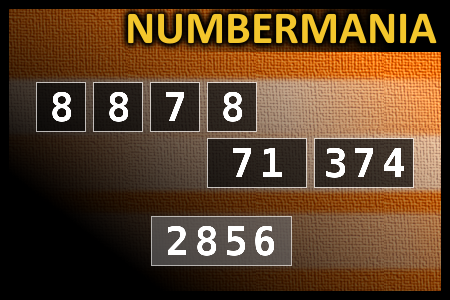
Calculate the number 2856
[317] Calculate the number 2856 - NUMBERMANIA: Calculate the number 2856 using numbers [8, 8, 7, 8, 71, 374] and basic arithmetic operations (+, -, *, /). Each of the numbers can be used only once. - #brainteasers #math #numbermania - Correct Answers: 30 - The first user who solved this task is Sanja Šabović
BRAIN TEASERS
enter your answer and press button OK

Calculate the number 2856

NUMBERMANIA: Calculate the number 2856 using numbers [8, 8, 7, 8, 71, 374] and basic arithmetic operations (+, -, *, /). Each of the numbers can be used only once.
Correct answers: 30
The first user who solved this task is Sanja Šabović.
#brainteasers #math #numbermania
Register with your Google Account and start collecting points.
Check your ranking on list.

One lovely morning, Ben and Th...

One lovely morning, Ben and Thomas were out golfing. Ben slices his ball deep into a wooded ravine. He grabs his 8-iron and proceeds down the embankment into the ravine in search of his ball. Ben searches diligently through the thick underbrush and suddenly he spots something shiny. As he gets closer, he realizes that the shiny object is in fact an 8-iron in the hands of a skeleton lying near an old golf ball.
Ben excitedly calls out to his golfing partner: "Hey Thomas, come here, I got big trouble down here."
Thomas comes running over to the edge of the ravine and calls out, "What's the matter Ben?"
Ben shouts back in a nervous voice, "Throw me my 7-iron! Looks like you can't get out of here with an 8-iron."
Jokes of the day - Daily updated jokes. New jokes every day.
Follow Brain Teasers on social networks

Brain Teasers

puzzles, riddles, mathematical problems, mastermind, cinemania...

Marchese Francesco Scipione Maffei

Born 1 Jun 1675; died 11 Feb 1755 at age 79.(marquess) Italian dramatist and archaeologist whose studies made from 1718 of the archaeology of his native town were published in his four-volume Verona illustrata (1731-32). From 1732, he spent four years pursuing archaeological research in France and also travelled through England, Holland and Germany. He built a museum to house his valuable collection, which he bequeathed to his native city. The Museo Lapidario holds many precious stone relics with runic Latin, Greek, Arabic, Egyptian, Persian and Hebrew inscriptions. He also was interested in physics and astronomy, and built his own observatory to study the movements of the stars. His hometown celebrated him with a statue in the Piazza de Signori.«
This site uses cookies to store information on your computer. Some are essential to help the site properly. Others give us insight into how the site is used and help us to optimize the user experience. See our privacy policy.