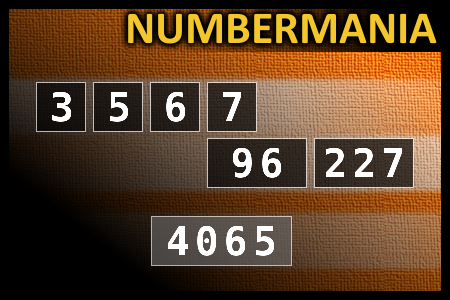
Calculate the number 4065
[516] Calculate the number 4065 - NUMBERMANIA: Calculate the number 4065 using numbers [3, 5, 6, 7, 96, 227] and basic arithmetic operations (+, -, *, /). Each of the numbers can be used only once. - #brainteasers #math #numbermania - Correct Answers: 27 - The first user who solved this task is Sanja Šabović
BRAIN TEASERS
enter your answer and press button OK

Calculate the number 4065

NUMBERMANIA: Calculate the number 4065 using numbers [3, 5, 6, 7, 96, 227] and basic arithmetic operations (+, -, *, /). Each of the numbers can be used only once.
Correct answers: 27
The first user who solved this task is Sanja Šabović.
#brainteasers #math #numbermania
Register with your Google Account and start collecting points.
Check your ranking on list.

Walking through Chinatown, a t...

Walking through Chinatown, a tourist is fascinated with all the Chinese restaurants, shops, signs and banners. He turns a corner and sees a building with the sign, "Hans Olaffsen's Laundry."
"Hans Olaffsen?" he muses. "How in hell does that fit in here?" So he walks into the shop and sees an old Chinese gentleman behind the counter.
The tourist asks, "How did this place get a name like 'Hans Olaffsen's Laundry?'" The old man answers, "Is name of owner."
The tourist asks, "Well, who and where is the owner?" "Me...is right here," replies the old man.
"You? How did you ever get a name like Hans Olaffsen?"
"Is simple," says the old man. "Many, many year ago when come to this country, was stand in line at Documentation Center. Man in front was big blonde Swede. Lady look at him and go, 'What your name?' He say,'Hans Olaffsen.' Then she look at me and go, 'What your name?'"
"I say Sem Ting."
Jokes of the day - Daily updated jokes. New jokes every day.
Follow Brain Teasers on social networks

Brain Teasers

puzzles, riddles, mathematical problems, mastermind, cinemania...

Wolfgang Pauli

Born 25 Apr 1900; died 15 Dec 1958 at age 58. Austrian-American physicist who was awarded the Nobel Prize for Physics in 1945 for his discovery in 1925 of the Pauli exclusion principle, which states that in an atom no two electrons can occupy the same quantum state simultaneously. This principle clearly relates the quantum theory to the observed properties of atoms.
This site uses cookies to store information on your computer. Some are essential to help the site properly. Others give us insight into how the site is used and help us to optimize the user experience. See our privacy policy.