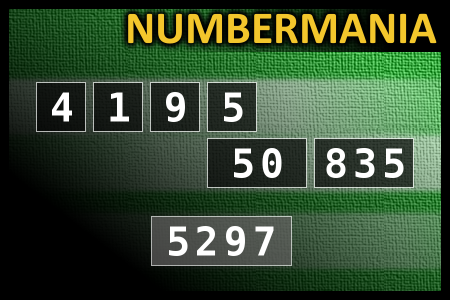
Calculate the number 5297
[792] Calculate the number 5297 - NUMBERMANIA: Calculate the number 5297 using numbers [4, 1, 9, 5, 50, 835] and basic arithmetic operations (+, -, *, /). Each of the numbers can be used only once. - #brainteasers #math #numbermania - Correct Answers: 27 - The first user who solved this task is Sanja Šabović
BRAIN TEASERS
enter your answer and press button OK

Calculate the number 5297

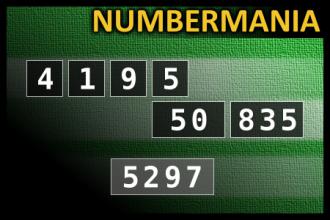
NUMBERMANIA: Calculate the number 5297 using numbers [4, 1, 9, 5, 50, 835] and basic arithmetic operations (+, -, *, /). Each of the numbers can be used only once.
Correct answers: 27
The first user who solved this task is Sanja Šabović.
#brainteasers #math #numbermania
Register with your Google Account and start collecting points.
Check your ranking on list.

Overcrowded Church

The two thousand member Baptist church was filled to overflowing capacity one Sunday morning. The preacher was ready to start the sermon when two men, dressed in long black coats and black hats entered thru the rear of the church.
One of the two men walked to the middle of the church while the other stayed at the back of the church. They both then reached under their coats and withdrew automatic weapons.
The one in the middle announced, "Everyone willing to take a bullet for Jesus stay in your seats!"
Naturally, the pews emptied, followed by the choir. The deacons ran out the door, followed by the choir director and the assistant pastor.
After a few moments, there were about twenty people left sitting in the church. The preacher was holding steady in the pulpit.
The men put their weapons away and said, gently, to the preacher, "All right, pastor, the hypocrites are gone now. You may begin the service."
Jokes of the day - Daily updated jokes. New jokes every day.
Follow Brain Teasers on social networks

Brain Teasers

puzzles, riddles, mathematical problems, mastermind, cinemania...

Johannes Robert Rydberg

Died 28 Dec 1919 at age 65 (born 8 Nov 1854).Swedish physicist, known for the Rydberg constant in his empirical formula that related the wave numbers of the spectral lines of an element (1890). This formula expressed fundamental relationships in those lines, which he presumed were the result of the inner nature and structure of an element's atoms. In 1897, he suggested that an atomic number for each of the elements, rather than atomic weights, would be a better means for organizing the elements and their periodicity of their characteristics. His work did provided the basis for discovering the electron shell structure of the atom. It was later established that the integer number of positive charges on an element's nucleus (its number of protons) corresponded to his idea of atomic number.«
This site uses cookies to store information on your computer. Some are essential to help the site properly. Others give us insight into how the site is used and help us to optimize the user experience. See our privacy policy.