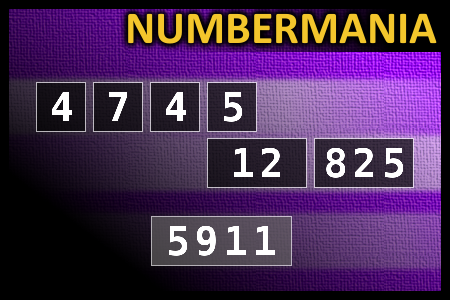
Calculate the number 5911
[488] Calculate the number 5911 - NUMBERMANIA: Calculate the number 5911 using numbers [4, 7, 4, 5, 12, 825] and basic arithmetic operations (+, -, *, /). Each of the numbers can be used only once. - #brainteasers #math #numbermania - Correct Answers: 28 - The first user who solved this task is Sanja Šabović
BRAIN TEASERS
enter your answer and press button OK

Calculate the number 5911

NUMBERMANIA: Calculate the number 5911 using numbers [4, 7, 4, 5, 12, 825] and basic arithmetic operations (+, -, *, /). Each of the numbers can be used only once.
Correct answers: 28
The first user who solved this task is Sanja Šabović.
#brainteasers #math #numbermania
Register with your Google Account and start collecting points.
Check your ranking on list.

Subway Party

Two small-town merchants were visiting New York City for the first time to attend a conference.

There was a large party thrown, with lots of food and drink. At the end of the party, they both staggered outside.

One guy crossed the street, while the other stumbled into a subway entrance.

When the 1st guy reached the other side of the street, he noticed the other emerging from the subway stairs.

"Where ya been?"

he slurred.

"I don't know," gushed the other guy, "but you should see the train set that guy has in his basement!"

Jokes of the day - Daily updated jokes. New jokes every day.
Follow Brain Teasers on social networks

Brain Teasers

puzzles, riddles, mathematical problems, mastermind, cinemania...

First newspaper weather map

In 1875, Sir Francis Galton published the first newspaper weather map - in The Times, London, England - now a standard feature in newspapers worldwide. He was the first to identify the anticyclone (as opposed to the cyclone), and introduced the use of charts showing areas of similar air pressure, as used on the modern weather map. Galton also devised several novel and ingenious mechanical instruments for recording information about the weather, while working at the Kew Observatory. He was also active as an explorer, anthropologist, statistician and criminologist. Galton was the first to place the study of fingerprints for identification on a scientific basis and so lay the groundwork for their use in criminal cases.[Image: Earlier work by Galton: a synchronous weather map of England drawn for 16 Jan 1861]
This site uses cookies to store information on your computer. Some are essential to help the site properly. Others give us insight into how the site is used and help us to optimize the user experience. See our privacy policy.