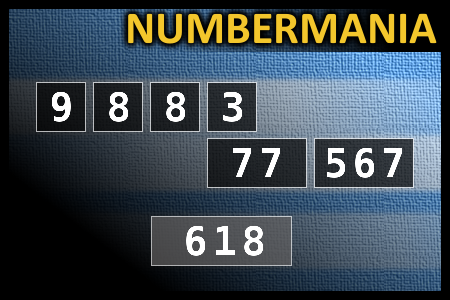
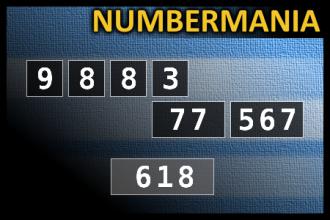
Calculate the number 618
[546] Calculate the number 618 - NUMBERMANIA: Calculate the number 618 using numbers [9, 8, 8, 3, 77, 567] and basic arithmetic operations (+, -, *, /). Each of the numbers can be used only once. - #brainteasers #math #numbermania - Correct Answers: 43 - The first user who solved this task is Sanja Šabović
BRAIN TEASERS
enter your answer and press button OK

Calculate the number 618

NUMBERMANIA: Calculate the number 618 using numbers [9, 8, 8, 3, 77, 567] and basic arithmetic operations (+, -, *, /). Each of the numbers can be used only once.
Correct answers: 43
The first user who solved this task is Sanja Šabović.
#brainteasers #math #numbermania
Register with your Google Account and start collecting points.
Check your ranking on list.

No one else sees life through your eyes

Don’t let anyone invalidate or minimize how you feel. If you feel something, you feel it and it’s real to you. Nothing anyone says has the power to invalidate that, ever. No one else lives in your body. No one else sees life through your eyes. No one else has lived through your experiences. And so, no one else has the right to dictate or judge how you feel. Your feelings are important and you deserve to be heard. They are inherently valid and they matter. Don’t let anyone make you believe otherwise.
Jokes of the day - Daily updated jokes. New jokes every day.
Follow Brain Teasers on social networks

Brain Teasers

puzzles, riddles, mathematical problems, mastermind, cinemania...

Frederick II

Died 13 Dec 1250 at age 55 (born 26 Dec 1194).Frederick II of Hohenstaufen was a German emperor and ornithologist who was a German ruler, residing in Sicily. He was a multilingual man of learning, who corresponded with and patronized scholars. He battled with the papacy, but otherwise practiced religious tolerance, and interacted with learned Jews, Muslims and Christians. His interest spanned science, especially natural history. He kept a menagerie which at various times had not only monkeys and camels, but also a giraffe and an elephant. His notable contribution to scientific ornithology was with a six-volume work, De arte venandi cum avibus (c.1244-48). In addition to some treatment of falconry, he presented his own observations (rather than perpetuating accepted hearsay knowledge) with remarks on hundreds of kinds of birds, with generalizations on their behaviour, anatomy and physiology. «[Miniature painting of Holy Roman Emperor Frederick II with a falcon from De arte venandi cum avibus, in Vatican Library.]
This site uses cookies to store information on your computer. Some are essential to help the site properly. Others give us insight into how the site is used and help us to optimize the user experience. See our privacy policy.