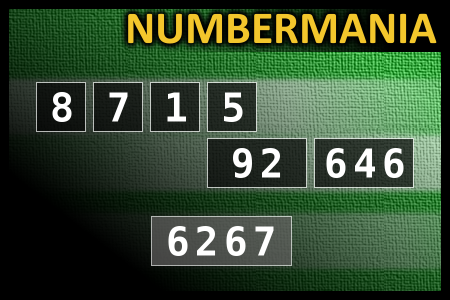

Calculate the number 6267
[1552] Calculate the number 6267 - NUMBERMANIA: Calculate the number 6267 using numbers [8, 7, 1, 5, 92, 646] and basic arithmetic operations (+, -, *, /). Each of the numbers can be used only once. - #brainteasers #math #numbermania - Correct Answers: 26 - The first user who solved this task is Sanja Šabović
BRAIN TEASERS
enter your answer and press button OK

Calculate the number 6267

NUMBERMANIA: Calculate the number 6267 using numbers [8, 7, 1, 5, 92, 646] and basic arithmetic operations (+, -, *, /). Each of the numbers can be used only once.
Correct answers: 26
The first user who solved this task is Sanja Šabović.
#brainteasers #math #numbermania
Register with your Google Account and start collecting points.
Check your ranking on list.

Door To Door

Two salesmen were going door to door, and knocked on the door of a woman who was not happy to see them. She told them in no uncertain terms that she did not want to hear their offer and slammed the door in their faces. To her surprise, however, the door did not close and, in fact, bounced back open. She tried again, really put her back into it, and slammed the door again with the same result-the door bounced back open.
Convinced these rude young people were sticking their foot in the door,she reared back to give it a slam that would teach them a lesson, when one of them said:

“Ma'am, before you do that again you need to move your cat.”

Jokes of the day - Daily updated jokes. New jokes every day.
Follow Brain Teasers on social networks

Brain Teasers

puzzles, riddles, mathematical problems, mastermind, cinemania...

Sydney Brenner

Born 13 Jan 1927. South African biologist who shared (with H. Robert Horvitz and John E. Sulston) the Nobel Prize in Physiology or Medicine for 2002 for their discoveries concerning how the genes regulate organ development and programmed cell death (apoptosis). Brenner established Caenorhabditis elegans as a model organism for the investigation of animal development including neural development. He chose this organism, a 1-mm-long soil roundworm, because of its simple structure, ease to grow in bulk populations, and finding that it is convenient for genetic analysis.
This site uses cookies to store information on your computer. Some are essential to help the site properly. Others give us insight into how the site is used and help us to optimize the user experience. See our privacy policy.