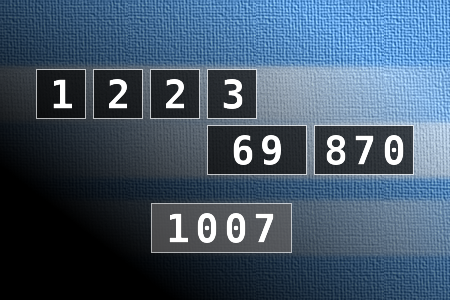
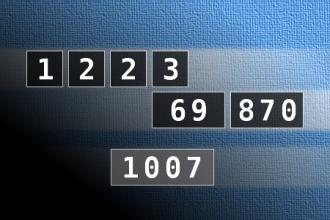
Calculate the number 1007
[7078] Calculate the number 1007 - NUMBERMANIA: Calculate the number 1007 using numbers [1, 2, 2, 3, 69, 870] and basic arithmetic operations (+, -, *, /). Each of the numbers can be used only once. - #brainteasers #math #numbermania - Correct Answers: 13 - The first user who solved this task is Nasrin 24 T
BRAIN TEASERS
enter your answer and press button OK

Calculate the number 1007

NUMBERMANIA: Calculate the number 1007 using numbers [1, 2, 2, 3, 69, 870] and basic arithmetic operations (+, -, *, /). Each of the numbers can be used only once.
Correct answers: 13
The first user who solved this task is Nasrin 24 T.
#brainteasers #math #numbermania
Register with your Google Account and start collecting points.
Check your ranking on list.

Burglary Witness

An old man was a witness in a burglary case.

The defense lawyer asked Sam, "Did you see my client commit this burglary?"

"Yes," said Sam, "I saw him plainly take the goods."

The lawyer asks Sam again, "Sam, this happened at night. Are you sure you saw my client commit this crime?"

"Yes, says Sam. "I saw him do it."

Then the lawyer asks Sam, "Sam, listen, you are an 80-year-old, and your eyesight is probably bad. Just how far can you see at night?"

Sam says, "I can see the moon. How far is that?"

Jokes of the day - Daily updated jokes. New jokes every day.
Follow Brain Teasers on social networks

Brain Teasers

puzzles, riddles, mathematical problems, mastermind, cinemania...

Atle Selberg

Born 14 Jun 1917; died 6 Aug 2007 at age 90.Norwegian mathematician who is one of the foremost analytic number theorists. After working in isolation during WW II, due to the occupation of Norway by the Nazis, his accomplishments in the theory of the Riemann zeta function became known. During the 1950's he developed the Selberg trace formula, his most famous accomplishment. It establishes a duality between the length spectrum of a Riemann surface and the eigenvalues of the Laplacian which is analogous to the duality between the prime numbers and the zeros of the zeta function. He was awarded the Fields Medal in 1950 for his work in number theory on generalisations of the sieve methods of Viggo Brun. In 1986 he won the Wolf Prize.
This site uses cookies to store information on your computer. Some are essential to help the site properly. Others give us insight into how the site is used and help us to optimize the user experience. See our privacy policy.