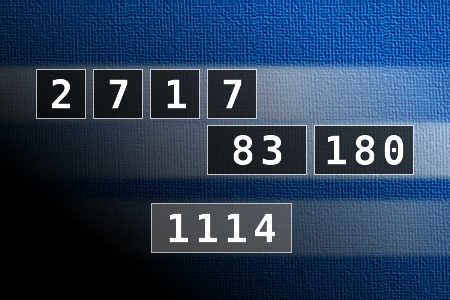
Calculate the number 1114
[6236] Calculate the number 1114 - NUMBERMANIA: Calculate the number 1114 using numbers [2, 7, 1, 7, 83, 180] and basic arithmetic operations (+, -, *, /). Each of the numbers can be used only once. - #brainteasers #math #numbermania - Correct Answers: 9 - The first user who solved this task is Nílton Corrêa de Sousa
BRAIN TEASERS
enter your answer and press button OK

Calculate the number 1114

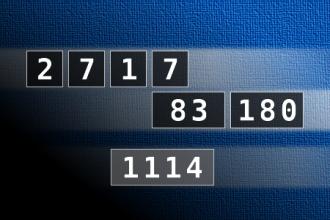
NUMBERMANIA: Calculate the number 1114 using numbers [2, 7, 1, 7, 83, 180] and basic arithmetic operations (+, -, *, /). Each of the numbers can be used only once.
Correct answers: 9
The first user who solved this task is Nílton Corrêa de Sousa.
#brainteasers #math #numbermania
Register with your Google Account and start collecting points.
Check your ranking on list.

A golfer, who was known for hi...

A golfer, who was known for his bad temper, walked into the Pro Shop one day and plunked down big bucks for a new set of woods.
The staff all watched to see what would happen after he used them for the first time - more than half expecting he'd come in and demand his money back.
But the next time he came in, he was all smiles.
"They're the best clubs I've ever had," he said. "In fact, I've discovered I can throw them at least 40 yards farther than I could my last ones."
Jokes of the day - Daily updated jokes. New jokes every day.
Follow Brain Teasers on social networks

Brain Teasers

puzzles, riddles, mathematical problems, mastermind, cinemania...

J. Georg Bednorz

Born 16 May 1950.Johannes Georg Bednorz is a German physicist who shared the 1987 Nobel Prize for Physics (with Karl Alex Müller) for their joint discovery of superconductivity in a new class of materials at temperatures higher than had previously been thought attainable. They startled the world by reporting superconductivity in a layered, ceramic material at a then record-high temperature of 33 kelvin (that is 33 degrees above absolute zero, or roughly -460 degrees Fahrenheit). Their discovery set off an avalanche of research worldwide into related materials that yielded dozens of new superconductors, eventually reaching a transition temperature of 135 kelvin. Today, he develops complex oxide compounds with novel crystal structures for possible uses in microelectronics.
This site uses cookies to store information on your computer. Some are essential to help the site properly. Others give us insight into how the site is used and help us to optimize the user experience. See our privacy policy.