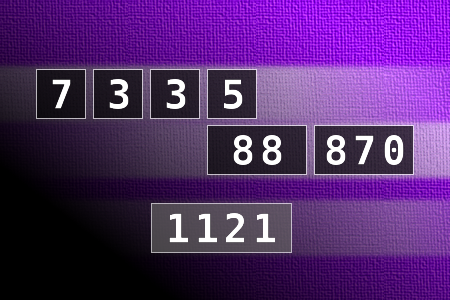
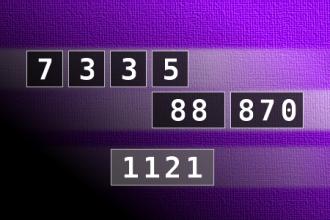
Calculate the number 1121
[5675] Calculate the number 1121 - NUMBERMANIA: Calculate the number 1121 using numbers [7, 3, 3, 5, 88, 870] and basic arithmetic operations (+, -, *, /). Each of the numbers can be used only once. - #brainteasers #math #numbermania - Correct Answers: 16 - The first user who solved this task is Djordje Timotijevic
BRAIN TEASERS
enter your answer and press button OK

Calculate the number 1121

NUMBERMANIA: Calculate the number 1121 using numbers [7, 3, 3, 5, 88, 870] and basic arithmetic operations (+, -, *, /). Each of the numbers can be used only once.
Correct answers: 16
The first user who solved this task is Djordje Timotijevic.
#brainteasers #math #numbermania

Register with your Google Account and start collecting points.
Check your ranking on list.

Bowling Team

Two bowling teams, one of all Blondes and one of all Brunettes, charter a double-decker bus for a weekend bowling tournament in Atlantic City. The Brunette team rides in the bottom of the bus. The Blonde team rides on the top level. The Brunette team down below is whooping it up having a great time, when one of them realises she doesn't hear anything from the Blondes upstairs.

She decides to go up and investigate. When the Brunette reaches the top, she finds all the Blondes frozen in fear, staring straight-ahead at the road, and clutching the seats in front of them with white knuckles.

She says, "What the heck's goin' on up here? We're havin' a grand time downstairs!" One of the Blondes looks up and says, "Yeah, but you've got a driver!"

Jokes of the day - Daily updated jokes. New jokes every day.
Follow Brain Teasers on social networks

Brain Teasers

puzzles, riddles, mathematical problems, mastermind, cinemania...

Robert Sanderson Mulliken

Born 7 Jun 1896; died 31 Oct 1986 at age 90. American chemist and physicist who received the 1966 Nobel Prize for Chemistry for “fundamental work concerning chemical bonds and the electronic structure of molecules.”In 1922, he first suggested a method of isotope separation by evaporative centrifuging. Thereafter, most of his research career was concerned with the interpretation of molecular spectra and with the application of quantum theory to the electronic states of molecules. With Friedrich Hund, he developed the molecular-orbital theory of chemical bonding, based on the idea that atomic orbitals of isolated atoms become molecular orbitals, extending over two or more atoms in the molecule. He also made major contributions to the theory and interpretation of molecular spectra.
This site uses cookies to store information on your computer. Some are essential to help the site properly. Others give us insight into how the site is used and help us to optimize the user experience. See our privacy policy.