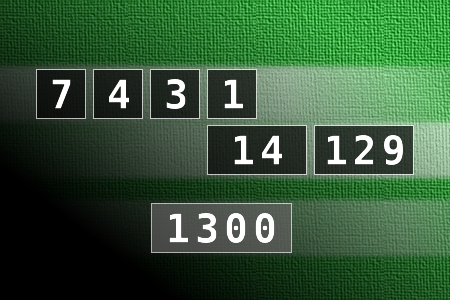
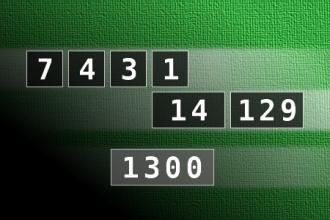
Calculate the number 1300
[7574] Calculate the number 1300 - NUMBERMANIA: Calculate the number 1300 using numbers [7, 4, 3, 1, 14, 129] and basic arithmetic operations (+, -, *, /). Each of the numbers can be used only once. - #brainteasers #math #numbermania - Correct Answers: 1
BRAIN TEASERS
enter your answer and press button OK

Calculate the number 1300

NUMBERMANIA: Calculate the number 1300 using numbers [7, 4, 3, 1, 14, 129] and basic arithmetic operations (+, -, *, /). Each of the numbers can be used only once.
Correct answers: 1
#brainteasers #math #numbermania
Register with your Google Account and start collecting points.
Check your ranking on list.

A pastor goes to the dentist f...

A pastor goes to the dentist for a set of false teeth.
The first Sunday after he gets his teeth, he talks for only eight minutes. The second Sunday, he talks for only 10 minutes. The following Sunday, he talks for two hours and 48 minutes.
The congregation has to mob him to get him down from the pulpit, and they ask him what happened.
The pastor explains the first Sunday his gums hurt so bad he couldn't talk for more than 8 minutes. The second Sunday his gums hurt too much to talk for more than 10 minutes.
But, the third Sunday, by mistake he put his wife's teeth in and couldn't stop talking.
Jokes of the day - Daily updated jokes. New jokes every day.
Follow Brain Teasers on social networks

Brain Teasers

puzzles, riddles, mathematical problems, mastermind, cinemania...

Robert Redfield

Born 4 Dec 1897; died 16 Oct 1958 at age 60.U.S. pioneer of urban anthropology. From his studies of Mexican communities, Redfield developed a theory (1956) of a folk-urban continuum, to account for the differences between folk society and urban society. A folk society was small in size, isolated, homogeneous, preliterate with a social and cultural life linked to kinship and sacred beliefs. Urban society had opposite of all these features. He believed that any community had a place on this continuum from folk to urban. This scale implied that simpler or folk forms of society would evolve to complex social forms with time. Anthropologists now consider the way folk and urban societies are part of a larger social, political and economic environment, rather than considered as separate poles on a continuum.
This site uses cookies to store information on your computer. Some are essential to help the site properly. Others give us insight into how the site is used and help us to optimize the user experience. See our privacy policy.