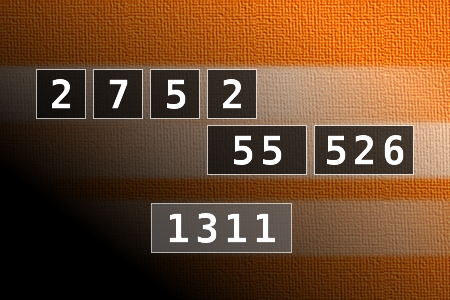
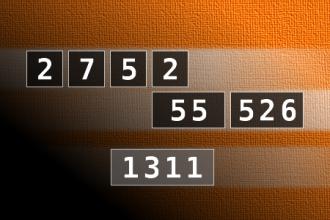
Calculate the number 1311
[4112] Calculate the number 1311 - NUMBERMANIA: Calculate the number 1311 using numbers [2, 7, 5, 2, 55, 526] and basic arithmetic operations (+, -, *, /). Each of the numbers can be used only once. - #brainteasers #math #numbermania - Correct Answers: 20 - The first user who solved this task is Djordje Timotijevic
BRAIN TEASERS
enter your answer and press button OK

Calculate the number 1311

NUMBERMANIA: Calculate the number 1311 using numbers [2, 7, 5, 2, 55, 526] and basic arithmetic operations (+, -, *, /). Each of the numbers can be used only once.
Correct answers: 20
The first user who solved this task is Djordje Timotijevic.
#brainteasers #math #numbermania
Register with your Google Account and start collecting points.
Check your ranking on list.

I can not tell a lie...

A married man and his secretary were having a torrid affair. One afternoon they couldn't contain their passion, so they rushed over to her place where they spent the afternoon making passionate love. When they were finished, they fell asleep, not waking until 8 o'clock that night.

They got dressed quickly. Then the man asked his secretary to take his shoes outside and rub them on the lawn. Bewildered, she did as he asked, thinking him pretty weird.

The man finally got home and his wife met him at the door. Upset, she asked where he'd been. The man replied, "I can not tell a lie. My secretary and I are having an affair. Today we left work early, went to her place, spent the afternoon making love, and then fell asleep. That's why I'm late."

The wife looked at him, took notice of his shoes, and yelled, "I can see those are grass stains on your shoes. YOU LIAR! You've been playing golf again, haven't you?"

Jokes of the day - Daily updated jokes. New jokes every day.
Follow Brain Teasers on social networks

Brain Teasers

puzzles, riddles, mathematical problems, mastermind, cinemania...

James S. Coleman

Died 25 Mar 1995 at age 68 (born 12 May 1926).James Samuel Coleman was an American sociologist who was a pioneer in mathematical sociology and whose studies strongly influenced education policy. In the early 1950s, he was as a chemical engineer with Eastman-Kodak Co. in Rochester, N.Y. He then changed direction, fascinated with sociology and social problems. In 1966, he presented a report to the U.S. Congress which concluded that poor black children did better academically in integrated, middle-class schools. His findings provided the sociological underpinnings for widespread busing of students to achieve racial balance in schools. In 1975, Coleman rescinded his support of busing, concluding that it had encouraged the deterioration of public schools by encouraging white flight to avoid integration.
This site uses cookies to store information on your computer. Some are essential to help the site properly. Others give us insight into how the site is used and help us to optimize the user experience. See our privacy policy.