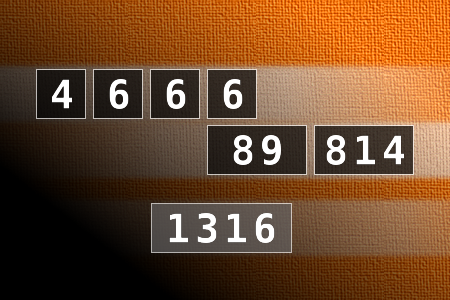
Calculate the number 1316
[6357] Calculate the number 1316 - NUMBERMANIA: Calculate the number 1316 using numbers [4, 6, 6, 6, 89, 814] and basic arithmetic operations (+, -, *, /). Each of the numbers can be used only once. - #brainteasers #math #numbermania - Correct Answers: 20 - The first user who solved this task is Nílton Corrêa de Sousa
BRAIN TEASERS
enter your answer and press button OK

Calculate the number 1316

NUMBERMANIA: Calculate the number 1316 using numbers [4, 6, 6, 6, 89, 814] and basic arithmetic operations (+, -, *, /). Each of the numbers can be used only once.
Correct answers: 20
The first user who solved this task is Nílton Corrêa de Sousa.
#brainteasers #math #numbermania
Register with your Google Account and start collecting points.
Check your ranking on list.

A Lesson – How to Find the Best Airline Price

I couldn’t decide whether to go to Salt Lake City or Denver for vacation, so I called the airlines to get prices. “Airfare to Denver is $300,” the cheery salesperson replied.
“And what about Salt Lake City?”
“We have a really great rate to Salt Lake—$99,” she said, “but there is a stopover.”
“Where?”
“In Denver,” she said.

Jokes of the day - Daily updated jokes. New jokes every day.
Follow Brain Teasers on social networks

Brain Teasers

puzzles, riddles, mathematical problems, mastermind, cinemania...

Ice cream cups

In 1903, a U.S. patent was issued for an ice cream cup mold to Italo Marchiony (No. 746,971). He came from Italy in 1895. From a pushcart on New York's Wall Street, he sold ice cream and lemon ice served in his baked waffles which he had folded by hand into the shape of a cup while still warm. Shortly, he had a chain of 45 carts operated by men he hired. Marchiony met the need for mass production with his invention of a multiple recess mold based on a waffle-iron. The bottom half of the mold was divided, to make it easy to separate it from the delicate baked cups. With two rows of five in each mold, it produced 10 cups at a time. In 1904, Marchiony took his confection to the Louisiana Exposition in St. Louis where he had the idea for the cone shape.
This site uses cookies to store information on your computer. Some are essential to help the site properly. Others give us insight into how the site is used and help us to optimize the user experience. See our privacy policy.