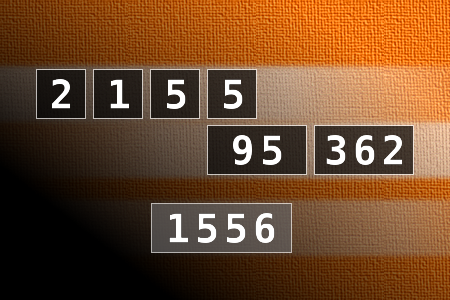
Calculate the number 1556
[6718] Calculate the number 1556 - NUMBERMANIA: Calculate the number 1556 using numbers [2, 1, 5, 5, 95, 362] and basic arithmetic operations (+, -, *, /). Each of the numbers can be used only once. - #brainteasers #math #numbermania - Correct Answers: 8 - The first user who solved this task is Nasrin 24 T
BRAIN TEASERS
enter your answer and press button OK

Calculate the number 1556

NUMBERMANIA: Calculate the number 1556 using numbers [2, 1, 5, 5, 95, 362] and basic arithmetic operations (+, -, *, /). Each of the numbers can be used only once.
Correct answers: 8
The first user who solved this task is Nasrin 24 T.
#brainteasers #math #numbermania
Register with your Google Account and start collecting points.
Check your ranking on list.

Bowling ball humor

I worry about the germs in the holes of bowling balls. Nobody cleans those holes. There are years of impacted pizza fingers in there. Taco fingers. Chicken fingers. I'm amazed those balls still have holes. Ever smell a bowling ball hole? You think the balls are knocking down the pins? You're wrong. The pins are passing out from the smell.

Jokes of the day - Daily updated jokes. New jokes every day.
Follow Brain Teasers on social networks

Brain Teasers

puzzles, riddles, mathematical problems, mastermind, cinemania...

Wilhelm Pfeffer

Died 31 Jan 1920 at age 74 (born 9 Mar 1845).Wilhelm (Friedrich Philipp) Pfeffer was a German botanist whose work on osmotic pressure made him a pioneer in the study of plant physiology. With Julius von Sachs, he was a leader in systematizing the fundamentals of plant physiology. In 1877, while investigating cell metabolism, he devised a semi-permeable membrane for the study osmosis. By measuring osmotic pressure, a technique he developed, Pfeffer found that pressure depends on the size of the molecules that are too large to pass through the membrane. Thus, he had a method to measure the size of such giant molecules. However, he was unable to find a mathematical relationship to predict osmotic pressure, which was furthered by the work of van't Hoff.
This site uses cookies to store information on your computer. Some are essential to help the site properly. Others give us insight into how the site is used and help us to optimize the user experience. See our privacy policy.