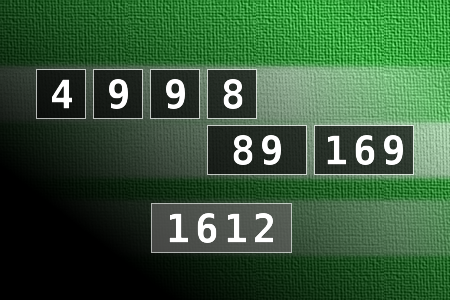
Calculate the number 1612
[7413] Calculate the number 1612 - NUMBERMANIA: Calculate the number 1612 using numbers [4, 9, 9, 8, 89, 169] and basic arithmetic operations (+, -, *, /). Each of the numbers can be used only once. - #brainteasers #math #numbermania - Correct Answers: 4
BRAIN TEASERS
enter your answer and press button OK

Calculate the number 1612

NUMBERMANIA: Calculate the number 1612 using numbers [4, 9, 9, 8, 89, 169] and basic arithmetic operations (+, -, *, /). Each of the numbers can be used only once.
Correct answers: 4
#brainteasers #math #numbermania

Register with your Google Account and start collecting points.
Check your ranking on list.

All the Beer You Can Drink for $1

A guy is walking around town when he sees a bar with a sign advertising "All the Beer You Can Drink for $1!"

He thinks that's a great deal so he goes in, sits down, hands the bartender a dollar, and asks for a beer.

"Sure, right away" says the bartender as he pulls out a tiny shot glass and fills it up halfway.

The man is stunned. "What the hell is this?" he asks.

"That's all the beer you can drink for $1."

Jokes of the day - Daily updated jokes. New jokes every day.
Follow Brain Teasers on social networks

Brain Teasers

puzzles, riddles, mathematical problems, mastermind, cinemania...

Fritz Wolfgang London

Born 7 Mar 1900; died 30 Mar 1954 at age 54.German-American physicist who, with Walter Heitler, devised the first quantum mechanical treatment of the hydrogen molecule, while working with Erwin Schrödinger at the University of Zurich. In a seminal paper (1927), they developed a wave equation for the hydrogen molecule with which it was possible to calculate approximate values of the molecule's ionization potential, heat of dissociation, and other constants. These predicted values were reasonably consistent with empirical values obtained by spectroscopic and chemical means. This theory of the chemical binding of homopolar molecules is considered one of the most important advances in modern chemistry. The approach is later called the valence-bond theory.
This site uses cookies to store information on your computer. Some are essential to help the site properly. Others give us insight into how the site is used and help us to optimize the user experience. See our privacy policy.