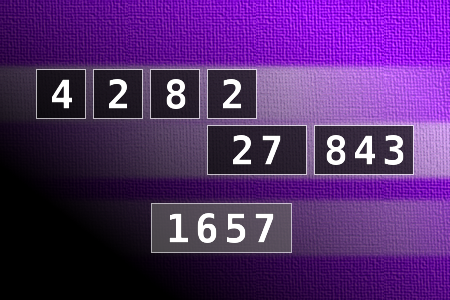
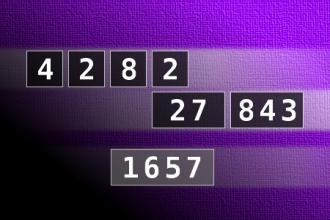
Calculate the number 1657
[6969] Calculate the number 1657 - NUMBERMANIA: Calculate the number 1657 using numbers [4, 2, 8, 2, 27, 843] and basic arithmetic operations (+, -, *, /). Each of the numbers can be used only once. - #brainteasers #math #numbermania - Correct Answers: 13 - The first user who solved this task is Nasrin 24 T
BRAIN TEASERS
enter your answer and press button OK

Calculate the number 1657

NUMBERMANIA: Calculate the number 1657 using numbers [4, 2, 8, 2, 27, 843] and basic arithmetic operations (+, -, *, /). Each of the numbers can be used only once.
Correct answers: 13
The first user who solved this task is Nasrin 24 T.
#brainteasers #math #numbermania
Register with your Google Account and start collecting points.
Check your ranking on list.

How Old Are You?

A woman walked up to a little old man rocking in a chair on his porch.
"I couldn't help noticing how happy you look," she said. "What's your secret for a long happy life?"
"I smoke three packs of cigarettes a day," he said. "I also drink a case of whiskey a week, eat fatty foods, and never exercise."
"That's amazing," the woman said. "How old are you?'
"Twenty-six," he said.
Jokes of the day - Daily updated jokes. New jokes every day.
Follow Brain Teasers on social networks

Brain Teasers

puzzles, riddles, mathematical problems, mastermind, cinemania...

Leon M. Lederman

Born 15 Jul 1922. Leon Max Lederman is an American physicist who, along with Melvin Schwartz and Jack Steinberger, received the Nobel Prize for Physics in1988 for their joint research and discovery (1960-62) of a new subatomic particle, the muon neutrino. Neutrinos are subatomic particles having no detectable mass and no electric charge, which travel at the speed of light. The discovery of muon neutrinos, a new type of neutrino, was followed by discoveries by other scientists of a number of different “families” of subatomic particle. Together, they now form a standard model, a scheme that has been used to classify all known elementary particles. He was director of the Fermi National Accelerator Laboratory in Batavia, Ill. (1979-89).
This site uses cookies to store information on your computer. Some are essential to help the site properly. Others give us insight into how the site is used and help us to optimize the user experience. See our privacy policy.