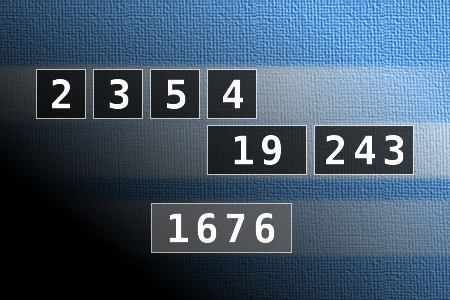
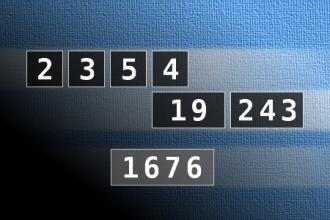
Calculate the number 1676
[4517] Calculate the number 1676 - NUMBERMANIA: Calculate the number 1676 using numbers [2, 3, 5, 4, 19, 243] and basic arithmetic operations (+, -, *, /). Each of the numbers can be used only once. - #brainteasers #math #numbermania - Correct Answers: 27 - The first user who solved this task is Djordje Timotijevic
BRAIN TEASERS
enter your answer and press button OK

Calculate the number 1676

NUMBERMANIA: Calculate the number 1676 using numbers [2, 3, 5, 4, 19, 243] and basic arithmetic operations (+, -, *, /). Each of the numbers can be used only once.
Correct answers: 27
The first user who solved this task is Djordje Timotijevic.
#brainteasers #math #numbermania
Register with your Google Account and start collecting points.
Check your ranking on list.

Ponderings Collection 04

Why is it called a "building" when it is already built?
Why do they call them "apartments" when they are all stuck together?
Why is there an expiration date on SOUR cream?
If you keep trying to prove Murphy's Law, will something keep going wrong?
Why does flammable and inflammable mean the same thing?
How can someone "draw a blank"?
Shouldn't there be a shorter word for "monosyllabic"?
Why is the word "abbreviate" so long?
Why did kamikaze pilots wear helmets?
What is another word for "thesaurus"?
Jokes of the day - Daily updated jokes. New jokes every day.
Follow Brain Teasers on social networks

Brain Teasers

puzzles, riddles, mathematical problems, mastermind, cinemania...

Alexander Goldenweiser

Born 29 Jan 1880; died 6 Jul 1940 at age 60.Alexander (Alexandrovich) Goldenweiser was an Russian-American anthropologist whose analyses of cultural questions ranged widely, encompassing intellectual movements in psychology and psychoanalysis. In particular, he suggested that cultural diffusion is not a mechanical process but, rather, depends in part on the receptiveness of cultures to proffered traits. Goldenweiser did very little field work in anthropology - less than ten months on six trips to the Iroquois on the Grand River reservation in Ontario (1911-13) - and is said to have disliked it. He was, however, a stimulating and versatile popular lecturer. Theory and methodology were his major concern, with folk psychology, religion and magic, and social organization in the forefront of his topical interests.
This site uses cookies to store information on your computer. Some are essential to help the site properly. Others give us insight into how the site is used and help us to optimize the user experience. See our privacy policy.