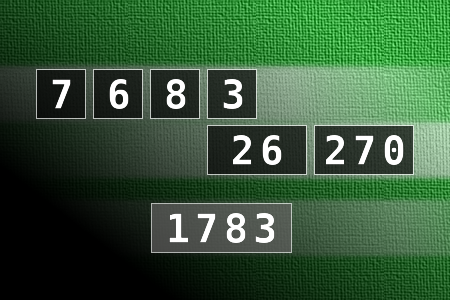
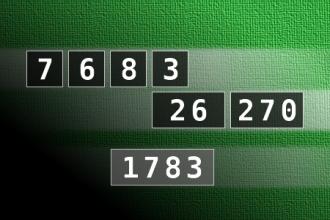
Calculate the number 1783
[5727] Calculate the number 1783 - NUMBERMANIA: Calculate the number 1783 using numbers [7, 6, 8, 3, 26, 270] and basic arithmetic operations (+, -, *, /). Each of the numbers can be used only once. - #brainteasers #math #numbermania - Correct Answers: 18 - The first user who solved this task is Djordje Timotijevic
BRAIN TEASERS
enter your answer and press button OK

Calculate the number 1783

NUMBERMANIA: Calculate the number 1783 using numbers [7, 6, 8, 3, 26, 270] and basic arithmetic operations (+, -, *, /). Each of the numbers can be used only once.
Correct answers: 18
The first user who solved this task is Djordje Timotijevic.
#brainteasers #math #numbermania
Register with your Google Account and start collecting points.
Check your ranking on list.

Dancing Duck

A circus owner walked into a bar to see everyone crowded about a table watching a little show. On the table was an upside down pot and a duck tap dancing on it. The circus owner was so impressed that he offered to buy the duck from its owner. After some wheeling and dealing, they settled for $10,000 for the duck and the pot.
Three days later the circus owner runs back to the bar in anger, "Your duck is a ripoff! I put him on the pot before a whole audience, and he didn't dance a single step!"
"So?" asked the ducks former owner, "did you remember to light the candle under the pot?"

Jokes of the day - Daily updated jokes. New jokes every day.
Follow Brain Teasers on social networks

Brain Teasers

puzzles, riddles, mathematical problems, mastermind, cinemania...

Lars Onsager

Died 5 Oct 1976 at age 72 (born 27 Nov 1903).Norwegian-born American chemist whose development of a general theory of irreversible chemical processes gained him the 1968 Nobel Prize for Chemistry. These Onsager reciprocal relations have importance in a wide range of applications. Throughout his career, he studied the thermodynamics and kinetics of electrolytes. In 1944 he derived the exact solution of the two-dimensional Ising model, a model of a ferromagnet. This virtuosic mathematical feat led to a deeper understanding of phase transitions and critical points. From about 1940 Onsager investigated low-temperature physics. He suggested the quantization of vortices in liquid helium, and in 1952 extracted information about the distribution of electrons from the de Haas-van Alphen effect.
This site uses cookies to store information on your computer. Some are essential to help the site properly. Others give us insight into how the site is used and help us to optimize the user experience. See our privacy policy.