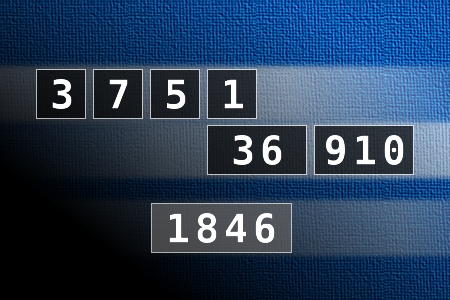

Calculate the number 1846
[6023] Calculate the number 1846 - NUMBERMANIA: Calculate the number 1846 using numbers [3, 7, 5, 1, 36, 910] and basic arithmetic operations (+, -, *, /). Each of the numbers can be used only once. - #brainteasers #math #numbermania - Correct Answers: 66 - The first user who solved this task is Nílton Corrêa de Sousa
BRAIN TEASERS
enter your answer and press button OK

Calculate the number 1846

NUMBERMANIA: Calculate the number 1846 using numbers [3, 7, 5, 1, 36, 910] and basic arithmetic operations (+, -, *, /). Each of the numbers can be used only once.
Correct answers: 66
The first user who solved this task is Nílton Corrêa de Sousa.
#brainteasers #math #numbermania
Register with your Google Account and start collecting points.
Check your ranking on list.

Stung by a bee

A woman taking golf lessons had just started her first round when she was stung by a bee. Distraught, she went back into the clubhouse and told her golf teacher about the incident.

"Where did it sting you?" he asked.

"Between the first and second hole," she replied.

He shook his head and said: "That’s your problem right there. You had your feet too far apart!"

Jokes of the day - Daily updated jokes. New jokes every day.
Follow Brain Teasers on social networks

Brain Teasers

puzzles, riddles, mathematical problems, mastermind, cinemania...

Pygmy mammoth

In 1994, the first near-complete fossil of a pygmy mammoth skeleton was found in rapidly eroding sea cliffs on Santa Rosa Island, one of the Channel Islands of California. This is the only full sized skeleton of the species anywhere in the world, and the first to be dated. Scientists estimate the age by radiocarbon dating at 12,840 years old. The specimen stood 5-1/2 feet tall, and weighed about a ton. The pony-sized species, Mammuthus exilis, a distant relative of the modern elephant, is believed to have lived only on San Miguel, Santa Rosa, and Santa Cruz islands. Partial pygmy mammoth remains had been documented in previous decades. Paleontologists continue to discover more sites with the remains of these Pleistocene-era animals.
This site uses cookies to store information on your computer. Some are essential to help the site properly. Others give us insight into how the site is used and help us to optimize the user experience. See our privacy policy.