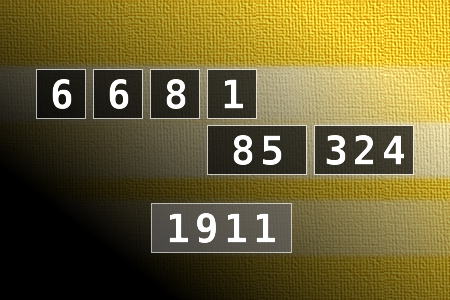
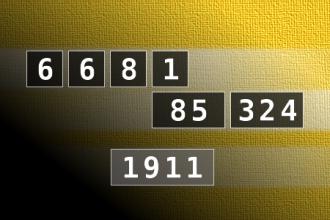
Calculate the number 1911
[7539] Calculate the number 1911 - NUMBERMANIA: Calculate the number 1911 using numbers [6, 6, 8, 1, 85, 324] and basic arithmetic operations (+, -, *, /). Each of the numbers can be used only once. - #brainteasers #math #numbermania - Correct Answers: 1
BRAIN TEASERS
enter your answer and press button OK

Calculate the number 1911

NUMBERMANIA: Calculate the number 1911 using numbers [6, 6, 8, 1, 85, 324] and basic arithmetic operations (+, -, *, /). Each of the numbers can be used only once.
Correct answers: 1
#brainteasers #math #numbermania
Register with your Google Account and start collecting points.
Check your ranking on list.

How many does it take?

How many members of your astrological sign does it take to change a light bulb?
Part 2:
Libra: Er, two. Or maybe one. No - on second thought, make that two. Is that okay with you?
Scorpio: That information is strictly secret and shared only with the Enlightened Ones in the Star Chamber of the Ancient Hierarchical Order.
Sagittarius: The sun is shining, the day is young and we've got our whole lives ahead of us, and you're inside worrying about a stupid light bulb?
Capricorn: I don't waste my time with these childish jokes.
Aquarius: Well, you have to remember that everything is energy, so...
Pisces: Light bulb? What light bulb?
Jokes of the day - Daily updated jokes. New jokes every day.
Follow Brain Teasers on social networks

Brain Teasers

puzzles, riddles, mathematical problems, mastermind, cinemania...

Erastus Brigham Bigelow

Born 2 Apr 1814; died 6 Dec 1879 at age 65. American industrialist, noted as the developer of the power loom for making lace and many types of carpet. At the age of 23 he invented his first loom for making coach lace (20 Apr 1837). Bigelow followed this with other power looms for weaving a variety of figured fabrics, tapestry carpeting, and ingrain carpeting. He obtained a patent for a power carpet loom on 26 May 1842. On 10 Apr 1845, he recieved the first U.S. patent for gingham manufacturing machinery. In 1861, he was a member of the committee that founded the Massachusetts Institute of Technology (MIT).
This site uses cookies to store information on your computer. Some are essential to help the site properly. Others give us insight into how the site is used and help us to optimize the user experience. See our privacy policy.