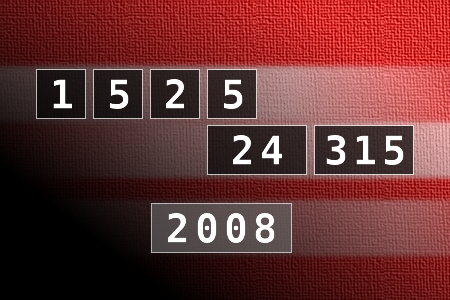
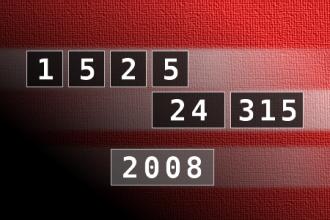
Calculate the number 2008
[6205] Calculate the number 2008 - NUMBERMANIA: Calculate the number 2008 using numbers [1, 5, 2, 5, 24, 315] and basic arithmetic operations (+, -, *, /). Each of the numbers can be used only once. - #brainteasers #math #numbermania - Correct Answers: 10 - The first user who solved this task is Fazil Hashim
BRAIN TEASERS
enter your answer and press button OK

Calculate the number 2008

NUMBERMANIA: Calculate the number 2008 using numbers [1, 5, 2, 5, 24, 315] and basic arithmetic operations (+, -, *, /). Each of the numbers can be used only once.
Correct answers: 10
The first user who solved this task is Fazil Hashim.
#brainteasers #math #numbermania
Register with your Google Account and start collecting points.
Check your ranking on list.

Indian Birth Names

This Indian boy goes to his mother one day with a puzzled look on his face.

"Say, mom, why is my bigger brother named "Mighty Storm"?

"Because he was conceived during a mighty storm."

"Why is my sister named "Cornflower"?

"Well, your father and I were in a cornfield, when we made her."

"And why is my other sister called "Moonchild"?

"We were watching the moon landing while she was conceived."

"Tell me, Torn Rubber, why are you so curious?"

Jokes of the day - Daily updated jokes. New jokes every day.
Follow Brain Teasers on social networks

Brain Teasers

puzzles, riddles, mathematical problems, mastermind, cinemania...

Karl Spencer Lashley

Died 7 Aug 1958 at age 68 (born 7 Jun 1890).Karl Spencer Lashley was an American psychologist who conducted quantitative investigations of the relation between brain mass and learning ability. He collaborated with Shepherd J. Franz in the study of intelligence and the role of the frontal lobes. Lashley promulgated the theory of cortical specialization for sensory and motor functions. He challenged the ongoing concept of cortical localization. The controversy between localization and holistic emphasis of brain function was brought into focus by Lashley. He is remembered as a great psychologist who approached learning and memory by assessing the effects of brain damage in laboratory animals.
This site uses cookies to store information on your computer. Some are essential to help the site properly. Others give us insight into how the site is used and help us to optimize the user experience. See our privacy policy.