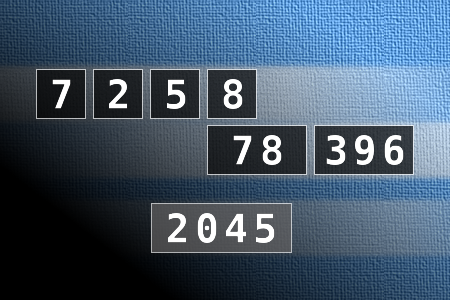

Calculate the number 2045
[4927] Calculate the number 2045 - NUMBERMANIA: Calculate the number 2045 using numbers [7, 2, 5, 8, 78, 396] and basic arithmetic operations (+, -, *, /). Each of the numbers can be used only once. - #brainteasers #math #numbermania - Correct Answers: 20 - The first user who solved this task is Djordje Timotijevic
BRAIN TEASERS
enter your answer and press button OK

Calculate the number 2045

NUMBERMANIA: Calculate the number 2045 using numbers [7, 2, 5, 8, 78, 396] and basic arithmetic operations (+, -, *, /). Each of the numbers can be used only once.
Correct answers: 20
The first user who solved this task is Djordje Timotijevic.
#brainteasers #math #numbermania
Register with your Google Account and start collecting points.
Check your ranking on list.

Shrinking Clothes

Pete went into the doctor's office for his annual checkup, and the Doc asked if there was anything unusual he should know about.

So Pete told the Doc that his suit must have shrunk over the last year, because it didn't fit when he went to get ready for a wedding recently.

The Doc said, "Suits don't shrink just sitting in a closet. You probably put on a few pounds."

"That's just it, Doc, I know I haven't gained a single pound since the last time I wore it."

"Well, then," said Doc, "You must have a case of Furniture Disease."

"What in the world is Furniture Disease?" asked Pete.

"That's when your chest starts sliding down into your drawers.".

Jokes of the day - Daily updated jokes. New jokes every day.
Follow Brain Teasers on social networks

Brain Teasers

puzzles, riddles, mathematical problems, mastermind, cinemania...

Karl Pearson

Born 27 Mar 1857; died 27 Apr 1936 at age 79. English mathematician who was one of the founders of modern statistics. His lectures as professor of geometry evolved into The Grammar of Science (1892), his most widely read book and a classic in the philosophy of science. Stimulated by the evolutionary writings of Francis Galton and a personal friendship with Walter F.R. Weldon, Pearson became immersed in the problem of applying statistics to biological problems of heredity and evolution. The methods he developed are essential to every serious application of statistics. From 1893 to 1912 he wrote a series of 18 papers entitled Mathematical Contributions to the Theory of Evolution, which contained much of his most valuable work, including the chi-square test of statistical significance.
This site uses cookies to store information on your computer. Some are essential to help the site properly. Others give us insight into how the site is used and help us to optimize the user experience. See our privacy policy.