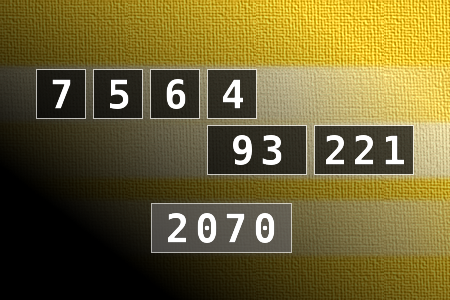
Calculate the number 2070
[5188] Calculate the number 2070 - NUMBERMANIA: Calculate the number 2070 using numbers [7, 5, 6, 4, 93, 221] and basic arithmetic operations (+, -, *, /). Each of the numbers can be used only once. - #brainteasers #math #numbermania - Correct Answers: 15 - The first user who solved this task is Djordje Timotijevic
BRAIN TEASERS
enter your answer and press button OK

Calculate the number 2070

NUMBERMANIA: Calculate the number 2070 using numbers [7, 5, 6, 4, 93, 221] and basic arithmetic operations (+, -, *, /). Each of the numbers can be used only once.
Correct answers: 15
The first user who solved this task is Djordje Timotijevic.
#brainteasers #math #numbermania
Register with your Google Account and start collecting points.
Check your ranking on list.

Would you like me to be your friend?

Kathy began a job as an elementary school counselor and she was eager to help.

One day, during recess, Kathy noticed a young girl standing by herself on one side of the playing field while the rest of the kids were playing a game of soccer.

A while later, Kathy walked over to the young girl and offered, "Would you like me to be your friend?"

The girl looked at Kathy suspiciously, then said hesitantly, "Okay, I guess so..."

"Why are you standing here all alone?" asked Kathy.

"Because," the little girl said with great exasperation, "I'm the goalie!"

Jokes of the day - Daily updated jokes. New jokes every day.
Follow Brain Teasers on social networks

Brain Teasers

puzzles, riddles, mathematical problems, mastermind, cinemania...

Martin Gardner

Died 22 May 2010 at age 95 (born 21 Oct 1914). American science writer who, for 25 years,wrote the highly popular “Mathematical Games” column for Scientific American. Though not an academic, nor having ever formally studied maths or science, he wrote widely and prolifically on both subjects, in such popular books as The Ambidextrous Universe and The Relativity Explosion. Since childhood, he was fascinated by magic, so one of his first books was Mathematics, Magic and Mystery (1956), about the maths of popular magic tricks. His interests grew wider and deeper. By age 42, he wrote his first column for Scientific American, and for many years thereafter popularized mathematics by highlighting puzzles that were elegantly understandable. He both inspired professionals and enchanted young readers to take an interest in mathematics.«
This site uses cookies to store information on your computer. Some are essential to help the site properly. Others give us insight into how the site is used and help us to optimize the user experience. See our privacy policy.