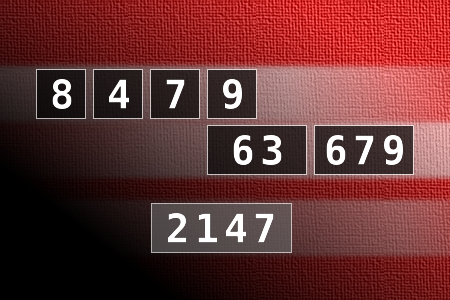
Calculate the number 2147
[8105] Calculate the number 2147 - NUMBERMANIA: Calculate the number 2147 using numbers [8, 4, 7, 9, 63, 679] and basic arithmetic operations (+, -, *, /). Each of the numbers can be used only once. - #brainteasers #math #numbermania - Correct Answers: 0
BRAIN TEASERS
enter your answer and press button OK

Calculate the number 2147

NUMBERMANIA: Calculate the number 2147 using numbers [8, 4, 7, 9, 63, 679] and basic arithmetic operations (+, -, *, /). Each of the numbers can be used only once.
Correct answers: 0
#brainteasers #math #numbermania
Register with your Google Account and start collecting points.
Check your ranking on list.

The Watch

Little Johnny sees that his friend at school has a new watch so he asks him how he got it.
"I waited until I heard the bedsprings squeaking in my folk's bedroom and then I ran in. My father gave me a watch to get rid of me.", replied the little friend.
Little Johnny, thinking that this was a cool idea waited that night until he heard the bedsprings squeaking rhythmically and then ran into his folk's bedroom.
"What do you want!", asked the father gruffly.
"I want a watch!", said Johnny.
"Well sit down and shut up!", replied the father.     

Jokes of the day - Daily updated jokes. New jokes every day.
Follow Brain Teasers on social networks

Brain Teasers

puzzles, riddles, mathematical problems, mastermind, cinemania...

Achromatic lenses

In 1758, optician John Dolland, having created achromatic lenses, reported this to the Royal Society. Isaac Newton had described the blurring effect due to chromatic abberation, but could not solve the problem in simple lenses, which was important in the preparation of lenses for telescopes and microscopes. A concave face of a lens of flint glass (which has a greater color dispersion than crown glass) is cemented to a convex face of a crown glass lens. Thus the dispersion properties causing chromatic aberration are removed from both lenses simultaneously. Although Dollond patented the discovery of the achromatic lens in the mid-18th century, it is widely believed that he was not its inventor, but learned about it from lens maker George Bass.
This site uses cookies to store information on your computer. Some are essential to help the site properly. Others give us insight into how the site is used and help us to optimize the user experience. See our privacy policy.