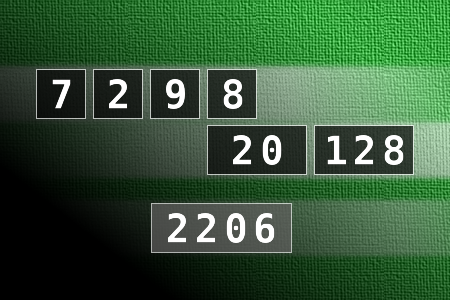
Calculate the number 2206
[7183] Calculate the number 2206 - NUMBERMANIA: Calculate the number 2206 using numbers [7, 2, 9, 8, 20, 128] and basic arithmetic operations (+, -, *, /). Each of the numbers can be used only once. - #brainteasers #math #numbermania - Correct Answers: 2
BRAIN TEASERS
enter your answer and press button OK

Calculate the number 2206

NUMBERMANIA: Calculate the number 2206 using numbers [7, 2, 9, 8, 20, 128] and basic arithmetic operations (+, -, *, /). Each of the numbers can be used only once.
Correct answers: 2
#brainteasers #math #numbermania
Register with your Google Account and start collecting points.
Check your ranking on list.

A man has a racehorse that nev...

A man has a racehorse that never won a race. The man says in disgust, "Horse, you win today or you pull a milk wagon tomorrow morning."
The starting gate opens and all the horses take off running except for the man's horse which is lying there asleep on the track.
He kicks the horse and asks, "Why are you sleeping?"
The sleepy horse raises his head and says, "I have to get up at 3 o'clock in the morning."
Jokes of the day - Daily updated jokes. New jokes every day.
Follow Brain Teasers on social networks

Brain Teasers

puzzles, riddles, mathematical problems, mastermind, cinemania...

Aspirin

In 1899, acetylsalycilic acid was patented by Felix Hoffmann. It is better known by its tradename as Aspirin. He had successfully created a chemically pure and stable form of acetylsalicylic acid in 1897. His handwritten laboratory notes suggested: “Through its physical characteristics such as a sour taste without any corrosive effect, acetylsalicylic acid has an advantage over salicylic acid and will therefore be tested for its usability in this context.”His success was Aspirin - a better pain reliever for his father's rheumatoid arthritis than the salicylic acid previously used, which had an unpleasant taste and side effects, such as stomach bleeding. Hoffmann had improved on the earlier impure form derived by French chemist Charles Frederic Gerhardt (1853).
This site uses cookies to store information on your computer. Some are essential to help the site properly. Others give us insight into how the site is used and help us to optimize the user experience. See our privacy policy.