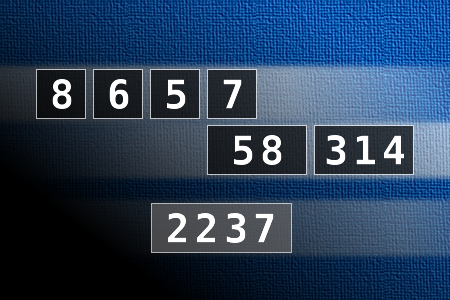

Calculate the number 2237
[7854] Calculate the number 2237 - NUMBERMANIA: Calculate the number 2237 using numbers [8, 6, 5, 7, 58, 314] and basic arithmetic operations (+, -, *, /). Each of the numbers can be used only once. - #brainteasers #math #numbermania - Correct Answers: 3

BRAIN TEASERS
enter your answer and press button OK

Calculate the number 2237

NUMBERMANIA: Calculate the number 2237 using numbers [8, 6, 5, 7, 58, 314] and basic arithmetic operations (+, -, *, /). Each of the numbers can be used only once.
Correct answers: 3
#brainteasers #math #numbermania
Register with your Google Account and start collecting points.
Check your ranking on list.

A man wakes up one morning to...

A man wakes up one morning to find a bear on his roof. So he looks in the yellow pages and sure enough, there's an ad for "Bear Removers."
He calls the number, and the bear remover says he'll be over in 30 minutes. The bear remover arrives, and gets out of his van. He's got a ladder, a baseball bat, a shotgun and a mean old pit bull.
"What are you going to do," the homeowner asks?
"I'm going to put this ladder up against the roof, then I'm going to go up there and knock the bear off the roof with this baseball bat. When the bear falls off, the pit bull is trained to grab his testicles and not let go. The bear will then be subdued enough for me to put him in the cage in the back of the van."
He hands the shotgun to the homeowner.
"What's the shotgun for?" asks the homeowner.
"If the bear knocks me off the roof, shoot the dog."
Jokes of the day - Daily updated jokes. New jokes every day.
Follow Brain Teasers on social networks

Brain Teasers

puzzles, riddles, mathematical problems, mastermind, cinemania...

Elliott Coues

Died 25 Dec 1899 at age 57 (born 9 Sep 1842).American army surgeon and ornithologist whose Key to North American Birds (1872) was the first work of its kind to present a taxonomic classification of birds according to an artificial key and promoted the systematic study of North American. Beginning the U.S. army as a medical cadet during the Civil War (1862), he became an assistant surgeon (1864-81). His interest in the study of birds began while a boy. He met many naturalists at the Smithsonian Institution and published his first technical paper at age 19. As his army assignments took him to various locations throughout the West, he continued studying the bird life in each new area, and found new species. He also did valuable work in mammalogy and wrote a book, Fur-Bearing Animals (1877).«
This site uses cookies to store information on your computer. Some are essential to help the site properly. Others give us insight into how the site is used and help us to optimize the user experience. See our privacy policy.