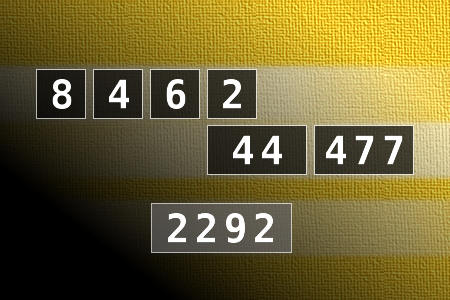
Calculate the number 2292
[8179] Calculate the number 2292 - NUMBERMANIA: Calculate the number 2292 using numbers [8, 4, 6, 2, 44, 477] and basic arithmetic operations (+, -, *, /). Each of the numbers can be used only once. - #brainteasers #math #numbermania - Correct Answers: 1
BRAIN TEASERS
enter your answer and press button OK

Calculate the number 2292

NUMBERMANIA: Calculate the number 2292 using numbers [8, 4, 6, 2, 44, 477] and basic arithmetic operations (+, -, *, /). Each of the numbers can be used only once.
Correct answers: 1
#brainteasers #math #numbermania
Register with your Google Account and start collecting points.
Check your ranking on list.

A man running late for his once in a lifetime dream...

A man running late for his once in a lifetime dream job interview is frantically trying to find a parking spot in a packed lot...

Time is not on his side, and he starts to panic. In his last ditch attempt, he turns to the skies, and begs: “God, please, help me out here. I’ll do anything… I’ll quit smoking. I’ll stop drinking. I’ll donate money to charity.” As soon as he finishes his plea, the skies open up, and the bright light shines on to an empty parking space. The man holds up his hand, and goes: “Never mind, I found one”.

Jokes of the day - Daily updated jokes. New jokes every day.
Follow Brain Teasers on social networks

Brain Teasers

puzzles, riddles, mathematical problems, mastermind, cinemania...

Kenichi Fukui

Died 9 Jan 1998 at age 79 (born 4 Oct 1918).Japanese chemist whosharedthe 1981 Nobel Prize for Chemistry with Roald Hoffmann for investigation of the mechanisms of chemical reactions. In 1952, at Kyoto University, Fukui introduced his “frontier orbital theory of reactions.”He proposed that the course of a reaction is determined by geometry and relative energies of molecular orbitals of reactants. The theory explains electrophilic attack, for example, occurs at the carbon atom having the greatest density of frontier (highest energy) electrons. In the mid-1960s, Fukui and Hoffmann discovered—almost simultaneously and independently of each other—that symmetry properties of frontier orbitals could explain certain reaction courses that had previously been difficult to understand.
This site uses cookies to store information on your computer. Some are essential to help the site properly. Others give us insight into how the site is used and help us to optimize the user experience. See our privacy policy.